HomeManaged ServicesNext Gen IT-InfraMonitoring & ManagementCyber SecurityBCP / DRAutomation
Managed Services
msp-dubai-accounting-firms-managed-it

Why accounting firms in Dubai need an MSP before they think they do?

🕓 April 24, 2026

Next Gen IT-Infra
Cato’s SASE Supports Cybersecurity Skills Development

How Cato’s SASE Supports Cybersecurity Skills Development

🕓 April 8, 2025

How SASE Supports the Security Needs of SMBs

How SASE Supports the Security Needs of SMBs

🕓 February 9, 2025

Attack Surface Reduction with Cato’s SASE

Attack Surface Reduction with Cato’s SASE

🕓 February 10, 2025

SASE for Digital Transformation in UAE

SASE for Digital Transformation in UAE

🕓 February 8, 2025

Monitoring & Management
Understanding Atera’s SLA Management

Understanding Atera’s SLA Management

🕓 February 7, 2025

Cost-Performance Ratio: Finding the Right Balance in IT Management Networks

Cost-Performance Ratio: Finding the Right Balance in IT Management Networks

🕓 June 16, 2025

Atera’s Communication Tools

Atera’s Communication Tools: Boosting IT Team Productivity in the UAE

🕓 February 8, 2025

Emerging Trends in IT Management

Emerging Trends in IT Management

🕓 February 10, 2025

Cyber Security
Illustration of the Cato Cloud architecture showing its role in delivering SASE for secure, optimized global connectivity.

Understanding the Cato Cloud and Its Role in SASE

🕓 January 29, 2025

Isometric illustration of professionals managing network performance, bandwidth analytics, and cloud-based optimization around the Cato Networks platform, symbolizing bandwidth control and QoS visibility.

Mastering Bandwidth Control and QoS in Cato Networks

🕓 July 26, 2025

Global network backbone powering Cato SASE solution for secure, high-performance connectivity across regions.

Global Backbone: The Engine Powering Cato’s SASE Solution

🕓 January 30, 2025

Illustration of team analyzing application traffic and usage insights on a large laptop screen using Cato’s dashboard, surrounded by network and cloud icons.

Cato Networks Application Visibility | Monitoring & Control

🕓 July 27, 2025

BCP / DR
Illustration showing diverse business and IT professionals collaborating with cloud, backup, and security icons, representing Vembu use cases for SMBs, MSPs, and IT teams.

Who Uses Vembu? Real-World Use Cases for SMBs, MSPs & IT Teams

🕓 July 12, 2025

Graphic showcasing Vembu’s all-in-one backup and disaster recovery platform with icons for cloud, data protection, and business continuity for IT teams and SMBs.

What Is Vembu? A Deep Dive Into the All in One Backup & Disaster Recovery Platform

🕓 July 6, 2025

Illustration showing Vembu backup and disaster recovery system with cloud storage, server racks, analytics dashboard, and IT professionals managing data.

The Rising Cost of Data Loss: Why Backup Is No Longer Optional?

🕓 August 14, 2025

3D isometric illustration of cloud backup and data recovery infrastructure with laptop, data center stack, and digital business icons — FSD Tech

RPO & RTO: The Heart of Business Continuity

🕓 August 15, 2025

Automation
Cross-Functional Collaboration with ClickUp

Fostering Cross-Functional Collaboration with ClickUp for Multi-Departmental Projects

🕓 February 11, 2025

ClickUp Project Reporting

Revolutionizing Enterprise Reporting with ClickUp’s Advanced Analytics and Dashboards

🕓 June 16, 2025

ClickUp’s Design Collaboration and Asset Management Tools

Empowering Creative Teams with ClickUp’s Design Collaboration and Asset Management Tools

🕓 February 26, 2025

ClickUp Communication and Collaboration Tools

ClickUp Communication and Collaboration Tools: Empowering Remote Teams

🕓 March 12, 2025

    Subscribe to our newsletter!

    About Us

    Follow Us

    Copyright © 2024 | Powered by 

    Atera

    (60)

    Cato Networks

    (131)

    ClickUp

    (78)

    FishOS

    (7)

    Miradore

    (21)

    PointGuard AI

    (9)

    Vembu

    (22)

    Xcitium

    (33)

    ZETA HRMS

    (79)

    Table of Contents

    CoS Queue Marking: Mapping 802.1p to Egress Queues for Enterprise Networks

    Surbhi Suhane
    April 24, 2026
    Comments
    CoS Queue Marking

    In the high-stakes world of enterprise networking, "Best Effort" is rarely good enough. When voice calls drop or video conferences lag, the culprit is often a lack of prioritization at the most fundamental level: the Data Link Layer (Layer 2). Class of Service (CoS) queue marking is the mechanism that ensures your most critical data—be it a CEO’s Zoom call or a high-frequency financial transaction—gets the "express lane" treatment through a switch.


    This guide provides an in-depth, technical exploration of CoS marking, how it interacts with egress queues, and how to maintain QoS consistency across your network infrastructure.


    Get a Free Network Performance Audit


    Understanding CoS: The Foundation of Layer 2 QoS

    Class of Service (CoS) refers to a 3-bit field within an Ethernet frame header, specifically defined by the IEEE 802.1p standard. Because it is only 3 bits long, it supports exactly eight possible values (0 through 7).


    The 802.1Q Tag Anatomy

    CoS does not exist in a standard "untagged" Ethernet frame. It is housed within the 802.1Q VLAN tag. When a frame is tagged for a specific VLAN, a 16-bit Tag Control Information (TCI) field is added. The first 3 bits of this TCI field are the Priority Code Point (PCP), commonly known as the CoS bits.


    Standard CoS Value Mappings

    While organizations can customize these, the industry generally follows these standard assignments:

    CoS ValuePriorityTraffic TypeTypical Use Case
    7HighestNetwork ControlRouting protocols (OSPF, BGP), STP
    6Very HighInternetwork ControlNetwork management (SSH, SNMP)
    5HighVoiceVoIP bearer traffic (RTP)
    4Medium-HighVideoVideo conferencing, streaming
    3MediumCritical ApplicationsDatabase queries, ERP systems
    2Low-MediumExcellent EffortPreferred business data
    1LowestBackgroundNon-critical transfers (Backups)
    0DefaultBest EffortStandard internet/web traffic


    The Mechanics of Marking: How Traffic is Tagged

    Marking is the process of setting the CoS bits in the frame header. This happens at the Trust Boundary—the point in the network where the administrator decides to "trust" the incoming markings or overwrite them based on policy.


    Ingress Classification

    Before a frame can be marked, it must be classified. A switch looks at incoming traffic and identifies it based on:

    • Port-based: All traffic on Port 1 is CoS 5.
    • Protocol-based: All RTP (Voice) traffic is CoS 5.
    • ACL-based: Traffic from a specific MAC or IP range is marked with a specific CoS.


    The Trust Boundary

    If a switch is connected to an IP phone, it might "trust" the CoS 5 marking coming from the phone. However, if a user’s PC sends traffic marked as CoS 7 (to try and cheat the system), the switch will typically "strip" or "remark" that traffic to CoS 0 at the trust boundary to prevent network abuse.


    Also Read: Point-to-Point Links: PPP and Dedicated Networks


    CoS to Queue Mapping: From Bits to Buffers

    Marking the bits is only half the battle. The actual "Quality of Service" happens when those bits are used to place the frame into a specific hardware buffer, or Egress Queue.


    The Hardware Queue Structure

    Modern switches (like the Cisco Nexus 9000 series or Allied Telesis x-series) have multiple physical egress queues per port. A common configuration is 1P7Q, meaning 1 Strict Priority (SP) queue and 7 Weighted Round Robin (WRR) queues.


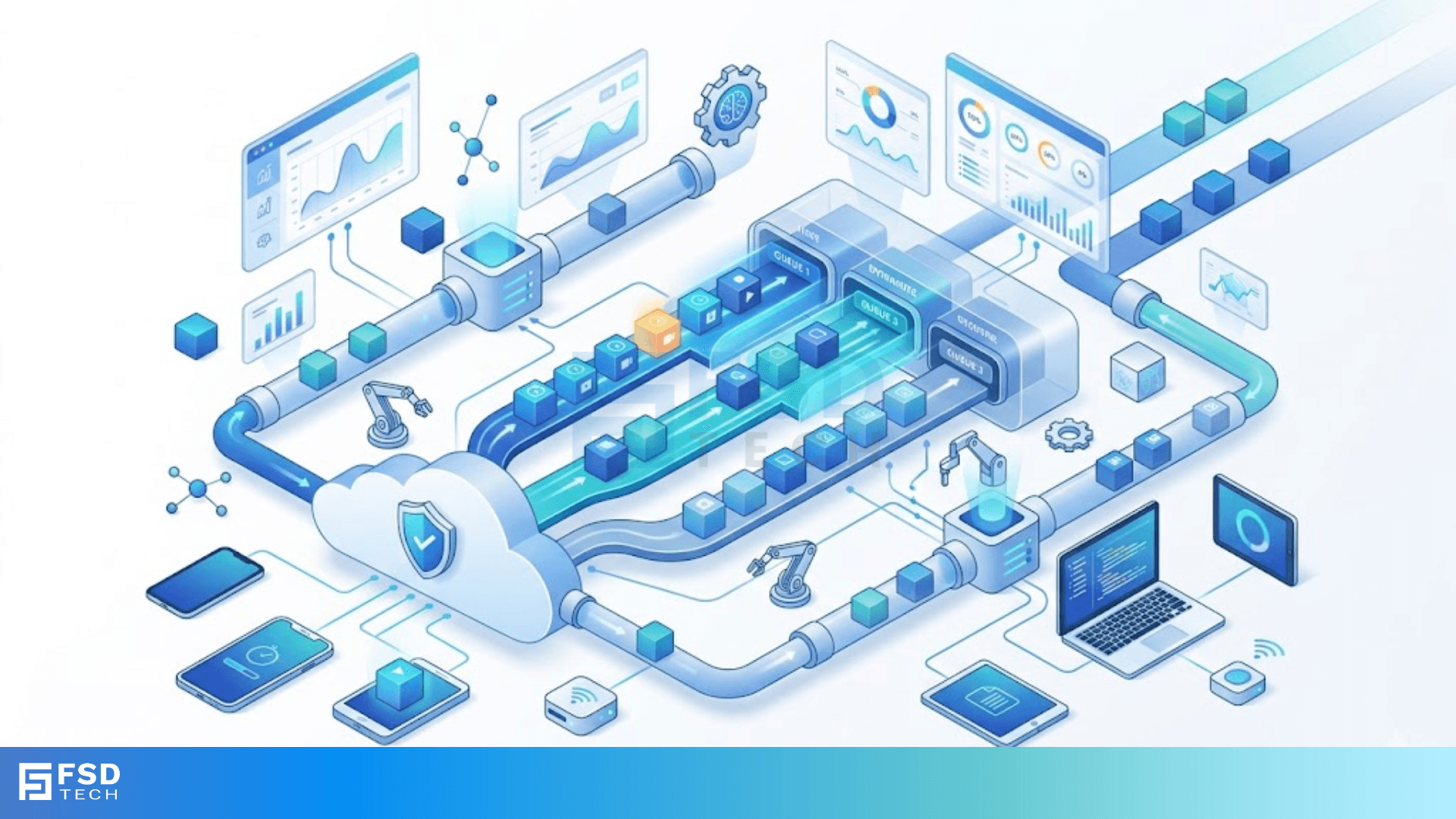
    1. The Mapping Table: The switch refers to an internal table that dictates: "If a frame has CoS 5, place it in Queue 7."
    2. Scheduling: The switch scheduler then decides which queue to service next.
      • Strict Priority (SP): The switch always empties Queue 7 before looking at any other queue. This is vital for Voice.
      • Weighted Round Robin (WRR): The switch gives a certain percentage of bandwidth to each queue (e.g., Queue 3 gets 20%, Queue 2 gets 10%).


    Also Read: Physical Layer Signaling: How Data Moves in Networking


    Cross-Layer Consistency: Mapping CoS to DSCP

    CoS is a Layer 2 (Data Link) property. Once a frame passes through a router and the MAC header is stripped, the CoS value is lost. To maintain QoS across the entire network (Layer 3), we must map CoS to DSCP (Differentiated Services Code Point).


    The Conversion Logic

    DSCP is a 6-bit field in the IP header (Layer 3), allowing for 64 levels of priority.


    • CoS to DSCP: When a frame enters a Layer 3 switch, the device copies the CoS value into the DSCP field. Usually, CoS 5 (Voice) is mapped to DSCP 46 (Expedited Forwarding - EF).
    • DSCP to CoS: When a packet is encapsulated into a frame to be sent over a trunk, the switch maps the DSCP value back to a CoS value.


    Formula for Simple Mapping:

    A common (though basic) mapping uses the 3 most significant bits of the DSCP value to determine the CoS. For instance, DSCP 46 (binary 101110) has the first three bits 101, which equals decimal 5. Thus, DSCP 46 maps to CoS 5.


    Conclusion

    CoS queue marking is the bedrock of a responsive, high-performance network. By correctly classifying traffic at the edge, marking it with the appropriate 802.1p bits, and mapping those bits to strategic egress queues, administrators can guarantee the performance of mission-critical applications. As networks transition toward more complex cloud-hybrid models, maintaining the integrity of these markings across both Layer 2 and Layer 3 becomes the difference between a seamless user experience and a productivity-killing bottleneck.


    Talk to a Network Architect


    Key Takeaways on Class of Service (CoS) queue marking

    • CoS is Layer 2: It lives in the 802.1Q VLAN tag and is limited to 8 priority levels (0-7).
    • Marking vs. Queuing: Marking identifies the traffic; queuing provides the actual differentiated treatment.
    • Strict Priority is for Voice: Always map CoS 5 to a Strict Priority queue to minimize jitter and latency.
    • Trust Boundaries are Critical: Only trust markings from known, authorized devices (like IP phones) to prevent "Priority Creep."
    • End-to-End QoS requires Mapping: You must map CoS to DSCP at the Layer 3 boundary to ensure priority is maintained across routers.


    Frequently Asked Questions (FAQs) on Class of Service (CoS) queue marking

    Q: What happens to CoS marking if the frame is untagged?

    A: Standard Ethernet frames (untagged) do not have a CoS field. In this case, the switch will assign a "Internal Priority" or "Port Default CoS" to the frame for queuing purposes while it is inside the switch.


    Q: Why use CoS if DSCP has more priority levels?

    A: CoS is essential for Layer 2 switches that do not look deep enough into the packet to see the IP header. It provides a fast, hardware-based way to prioritize frames within a LAN or across trunk links.


    Q: Can I use CoS 7 for my own applications?

    A: It is highly discouraged. CoS 7 and 6 are generally reserved for network control traffic (like Spanning Tree or OSPF). If you saturate these queues with application data, you risk causing a network-wide collapse because control packets won't get through.


    Q: Is CoS the same as 802.1p?

    A: Yes. 802.1p is the specific sub-standard of 802.1Q that defines the 3-bit Priority Code Point (PCP) field used for Class of Service.

    CoS Queue Marking: Mapping 802.1p to Egress Queues for Enterprise Networks

    About The Author

    Surbhi Suhane

    Surbhi Suhane is an experienced digital marketing and content specialist with deep expertise in Getting Things Done (GTD) methodology and process automation. Adept at optimizing workflows and leveraging automation tools to enhance productivity and deliver impactful results in content creation and SEO optimization.

    TRY OUR PRODUCTS

    Like This Story?

    Share it with friends!

    Subscribe to our newsletter!

    FishOSCato SASEVembuXcitiumZeta HRMSAtera
    Isometric illustration of a centralized performance platform connected to analytics dashboards and team members, representing goal alignment, measurable outcomes, risk visibility, and strategic project tracking within ClickUp.

    How ClickUp Enables Outcome-Based Project Management (Not Just Task Tracking)

    🕓 February 15, 2026
    Isometric illustration of a centralized executive dashboard platform connected to analytics panels, performance charts, security indicators, and strategic milestones, representing real-time business visibility and decision control within ClickUp.

    Executive Visibility in ClickUp – How CXOs Gain Real-Time Control Without Micromanaging

    🕓 February 13, 2026

    Cato SASE Architecture

    Inside Cato’s SASE Architecture: A Blueprint for Modern Security

    🕓 January 26, 2025

    Workflow Automation(8)

    Workforce Automation(1)

    AI Project Management(1)

    HR Data Automation(1)

    RMM(2)

    Firewall Security(1)

    IT Workflow Automation(1)

    GCC compliance(4)

    IT security(2)

    Payroll Integration(2)

    IT support automation(3)

    procurement automation(1)

    lost device management(1)

    IT Management(5)

    IoT Security(3)

    Cato XOps(1)

    IT compliance(5)

    Task Automation(1)

    Workflow Management(1)

    AI-powered cloud ops(1)

    OpenStack automation(1)

    Kubernetes lifecycle management(2)

    SMB Security(8)

    Data Security(1)

    MDR (Managed Detection & Response)(3)

    MSP Automation(3)

    Atera Integrations(2)

    Threat Detection & Response(1)

    XDR Security(2)

    SMB Cyber Protection(1)

    Ransomware Defense(3)

    HR Tech Solutions(1)

    Zero Trust Network Access(3)

    Post-Quantum Cryptography(1)

    Quantum Security(1)

    Quantum Threat UAE & GCC(1)

    Zero Trust Security(2)

    Cloud IDE Security(1)

    Endpoint Management(1)

    SaaS Security(2)

    Payroll Automation(5)

    IT Monitoring(2)

    Xcitium EDR SOC(15)

    Ransomware Protection GCC(1)

    Network Consolidation UAE(1)

    M&A IT Integration(1)

    MSSP for SMBs(1)

    SMB Cybersecurity GCC(1)

    FSD-Tech MSSP(25)

    Antivirus vs EDR(1)

    Managed EDR FSD-Tech(1)

    Ransomware Protection(3)

    Cybersecurity GCC(15)

    Endpoint Security(1)

    Data Breach Costs(1)

    Endpoint Protection(1)

    Xcitium EDR(30)

    SMB Cybersecurity(8)

    Managed Security Services(2)

    Zero Dwell Containment(31)

    Hybrid Backup(1)

    Cloud Backup(1)

    Backup & Recovery(1)

    pointguard ai(4)

    vembu(9)

    SMB data protection(9)

    disaster recovery myths(1)

    backup myths(1)

    Disaster Recovery(4)

    Vembu BDR Suite(19)

    GCCBusiness(1)

    DataProtection(1)

    Unified Network Management(1)

    Secure Access Service Edge(4)

    GCC IT Solutions(1)

    GCC HR software(20)

    financial cybersecurity(2)

    CC compliance(1)

    open banking(1)

    Miradore EMM(15)

    Government Security(1)

    Cato SASE(9)

    Cloud Security(9)

    Hybrid Learning(1)

    GCC Education(1)

    Talent Development(1)

    AI Governance(4)

    AI Risk Management(1)

    AI Compliance(2)

    AI Security(2)

    AI Cybersecurity(13)

    Secure Remote Access(1)

    GCC business security(1)

    GCC network integration(1)

    compliance automation(5)

    education security(1)

    GCC cybersecurity(3)

    BYOD security Dubai(8)

    App management UAE(1)

    Miradore EMM Premium+(5)

    share your thoughts

    CoS Queue Marking

    CoS Queue Marking: Mapping 802.1p to Egress Queues for Enterprise Networks

    🕓 April 24, 2026

    DECnet Phase Routing

    DECnet Phase Routing: Evolution, Architecture, and Protocols

    🕓 April 24, 2026

    HTTPS TLS Handshake

    HTTPS TLS Handshake: How Your Browser Stays Safe

    🕓 April 23, 2026

    Managed Services(1)

    Decoded(221)

    Cyber Security(128)

    BCP / DR(22)

    Zeta HRMS(78)

    SASE(21)

    Automation(80)

    Next Gen IT-Infra(128)

    Monitoring & Management(81)

    ITSM(22)

    HRMS(21)

    Automation(24)