HomeNext Gen IT-InfraMonitoring & ManagementCyber SecurityBCP / DRAutomationDecoded
Next Gen IT-Infra
Cato’s SASE Supports Cybersecurity Skills Development

How Cato’s SASE Supports Cybersecurity Skills Development

🕓 April 8, 2025

How SASE Supports the Security Needs of SMBs

How SASE Supports the Security Needs of SMBs

🕓 February 9, 2025

Attack Surface Reduction with Cato’s SASE

Attack Surface Reduction with Cato’s SASE

🕓 February 10, 2025

SASE for Digital Transformation in UAE

SASE for Digital Transformation in UAE

🕓 February 8, 2025

Monitoring & Management
Understanding Atera’s SLA Management

Understanding Atera’s SLA Management

🕓 February 7, 2025

Cost-Performance Ratio: Finding the Right Balance in IT Management Networks

Cost-Performance Ratio: Finding the Right Balance in IT Management Networks

🕓 June 16, 2025

Customizing Atera with APIs

Customizing Atera with APIs

🕓 March 3, 2025

Power Up Your IT Team’s Strategy with Atera’s Communication Tools

Power Up Your IT Team’s Strategy with Atera’s Communication Tools

🕓 February 8, 2025

Cyber Security
Illustration of the Cato Cloud architecture showing its role in delivering SASE for secure, optimized global connectivity.

Understanding the Cato Cloud and Its Role in SASE

🕓 January 29, 2025

Isometric illustration of professionals managing network performance, bandwidth analytics, and cloud-based optimization around the Cato Networks platform, symbolizing bandwidth control and QoS visibility.

Mastering Bandwidth Control and QoS in Cato Networks

🕓 July 26, 2025

Global network backbone powering Cato SASE solution for secure, high-performance connectivity across regions.

Global Backbone: The Engine Powering Cato’s SASE Solution

🕓 January 30, 2025

Illustration of team analyzing application traffic and usage insights on a large laptop screen using Cato’s dashboard, surrounded by network and cloud icons.

Cato Networks Application Visibility | Monitoring & Control

🕓 July 27, 2025

BCP / DR
Illustration showing diverse business and IT professionals collaborating with cloud, backup, and security icons, representing Vembu use cases for SMBs, MSPs, and IT teams.

Who Uses Vembu? Real-World Use Cases for SMBs, MSPs & IT Teams

🕓 July 12, 2025

Graphic showcasing Vembu’s all-in-one backup and disaster recovery platform with icons for cloud, data protection, and business continuity for IT teams and SMBs.

What Is Vembu? A Deep Dive Into the All in One Backup & Disaster Recovery Platform

🕓 July 6, 2025

Illustration showing Vembu backup and disaster recovery system with cloud storage, server racks, analytics dashboard, and IT professionals managing data.

The Rising Cost of Data Loss: Why Backup Is No Longer Optional?

🕓 August 14, 2025

3D isometric illustration of cloud backup and data recovery infrastructure with laptop, data center stack, and digital business icons — FSD Tech

RPO & RTO: The Heart of Business Continuity

🕓 August 15, 2025

Automation
Cross-Functional Collaboration with ClickUp

Fostering Cross-Functional Collaboration with ClickUp for Multi-Departmental Projects

🕓 February 11, 2025

ClickUp Project Reporting

Revolutionizing Enterprise Reporting with ClickUp’s Advanced Analytics and Dashboards

🕓 June 16, 2025

ClickUp’s Design Collaboration and Asset Management Tools

Empowering Creative Teams with ClickUp’s Design Collaboration and Asset Management Tools

🕓 February 26, 2025

ClickUp Communication and Collaboration Tools

ClickUp Communication and Collaboration Tools: Empowering Remote Teams

🕓 March 12, 2025

Decoded
Multi-Factor Authentication (MFA)

Multi-Factor Authentication (MFA): All You Need to Know

🕓 December 7, 2025

L3 Switch

What Is an L3 Switch? L2 vs L3 & Why You Need Layer 3?

🕓 December 8, 2025

IPSec

IPSec Explained: Protocols, Modes, IKE & VPN Security

🕓 December 3, 2025

 Datagram Transport Layer Security (DTLS)

What is Datagram Transport Layer Security (DTLS)? How it works?

🕓 December 4, 2025

    Subscribe to our newsletter!

    About Us

    Follow Us

    Copyright © 2024 | Powered by 

    Atera

    (59)

    Cato Networks

    (131)

    ClickUp

    (78)

    FishOS

    (7)

    Miradore

    (21)

    PointGuard AI

    (9)

    Vembu

    (22)

    Xcitium

    (33)

    ZETA HRMS

    (79)

    Table of Contents

    FishOS Health Monitoring: Full Visibility Across Your Cloud Infrastructure

    Anas Abdu Rauf
    September 22, 2025
    Comments
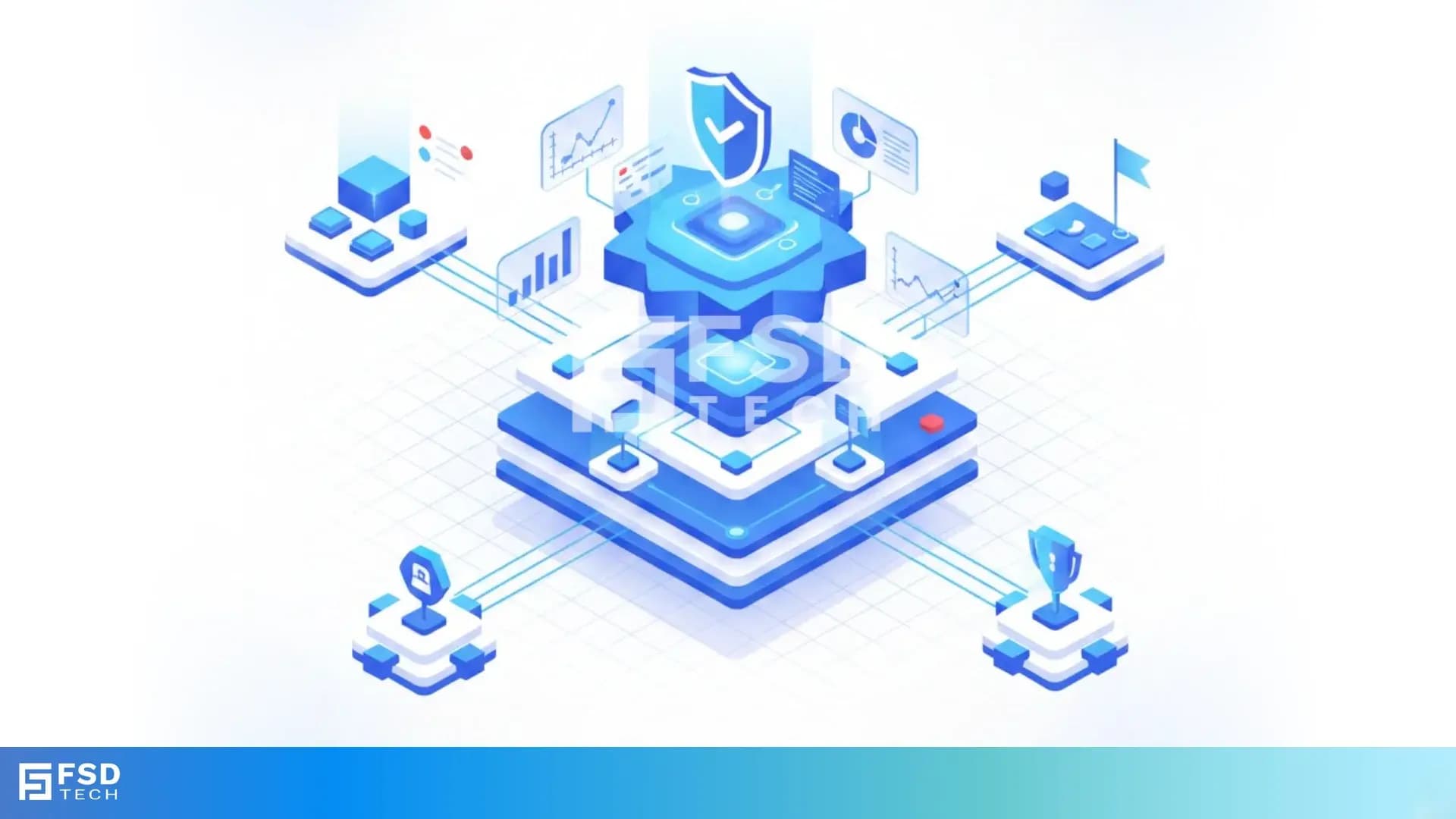
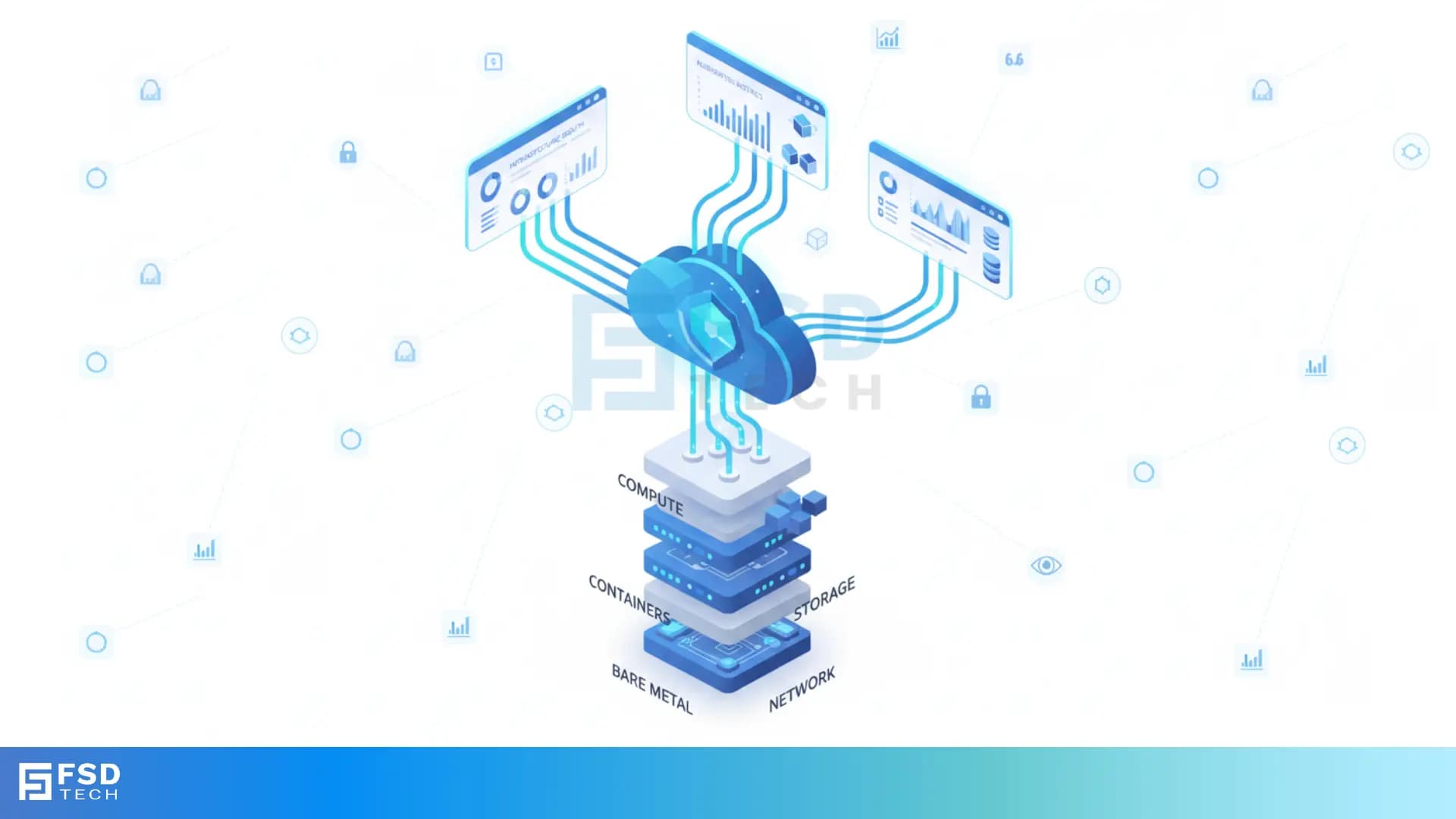
    3D illustration of FishOS cloud health monitoring by FSD Tech, showing layered observability from bare metal, network, storage, containers, and compute. Cloud dashboards display performance metrics and analytics for end-to-end monitoring.

    Introduction

    In enterprise cloud operations, maintaining uptime and performance is critical. FishOS Health Monitoring Service delivers a comprehensive observability layer that ensures full visibility across your infrastructure. The service monitors everything from bare metal servers to virtual machines, containers, storage systems, and networking, allowing teams to detect and address issues efficiently.
     

    This solution integrates the FishOS Health Engine with advanced open-source components, providing centralized telemetry, visual dashboards, and insights directly within the FishOS platform. With this approach, organizations can reduce operational complexity and maintain continuous cloud performance.


    Key Takeaways

    • Full-stack observability: FishOS monitors bare metal, hypervisors, VMs, containers, storage, and network layers.
    • Centralized telemetry: Logs, metrics, and events from all infrastructure layers are consolidated into a single pipeline for correlation and long-term analysis.
    • Role-specific dashboards: Provides real-time insights for admins, Kubernetes users, and storage engineers.
    • Integrated operations: Telemetry feeds Workload Manager and Lifecycle Engine for optimized workload placement and upgrade scheduling.
    • Long-term analytics: Supports retention of logs and metrics for audits, trend analysis, and operational planning.


    Core Capabilities

    Full-Stack Monitoring

    FishOS Health Monitoring provides visibility across all major infrastructure components:
     

    LayerMonitored Components
    Bare MetalFirmware events, power usage, thermal status
    ComputeHypervisors, CPU/memory/disk metrics
    ContainersKubernetes pod health, namespace performance
    StorageCeph pool health, IOPS, latency
    NetworkBandwidth usage, port errors, packet loss


    This comprehensive coverage ensures that all critical layers of your private cloud infrastructure are observed in real time.


    Telemetry Consolidation

    The Health Monitoring Service consolidates logs, metrics, and events from each infrastructure layer into a centralized telemetry pipeline. This pipeline standardizes data, making it possible to:

    • Correlate events across bare metal, compute, containers, storage, and network layers.
    • Visualize historical and real-time trends.
    • Enable long-term storage for compliance and audit purposes.

    By centralizing telemetry, FishOS reduces the operational complexity of managing multiple tools and dashboards.


    Dashboards and Visualization

    FishOS Health Monitoring includes role-specific dashboards, providing actionable insights for different teams:
     

    User RoleDashboard FeaturesVisual Placeholder
    AdminInfrastructure-wide health scores, performance trends, capacity usage![Admin Dashboard Placeholder]
    Kubernetes UserPod-level and namespace health, resource metrics, logs![Kubernetes Dashboard Placeholder]
    Storage EngineerCeph pool status, recovery tasks, disk health![Storage Dashboard Placeholder]


    Dashboards provide drill-down navigation for fast troubleshooting and real-time monitoring.


    Integration with FishOS Operations

    Telemetry from Health Monitoring informs Workload Manager and Lifecycle Engine:

    • Workload Manager: Uses real-time metrics to optimize workload placement, reduce resource contention, and improve performance.
    • Lifecycle Engine: Leverages telemetry trends to schedule upgrades and maintenance during periods of low usage, minimizing operational impact.

    This integration ensures that monitoring is not just passive observation but actively informs operational decisions.


    Benefits

    1. Proactive Issue Detection: Identify potential problems early, reducing downtime and SLA violations.
    2. Simplified Operations: Centralized telemetry removes the need for multiple monitoring tools.
    3. Operational Efficiency: Role-specific dashboards and insights help operators focus on critical issues.
    4. Long-Term Analytics: Historical data supports audits, trend analysis, and incident investigations.


    Book a free consultation with our experts to explore how FishOS Health Monitoring can reduce downtime, simplify operations, and improve performance in your cloud. Book Now

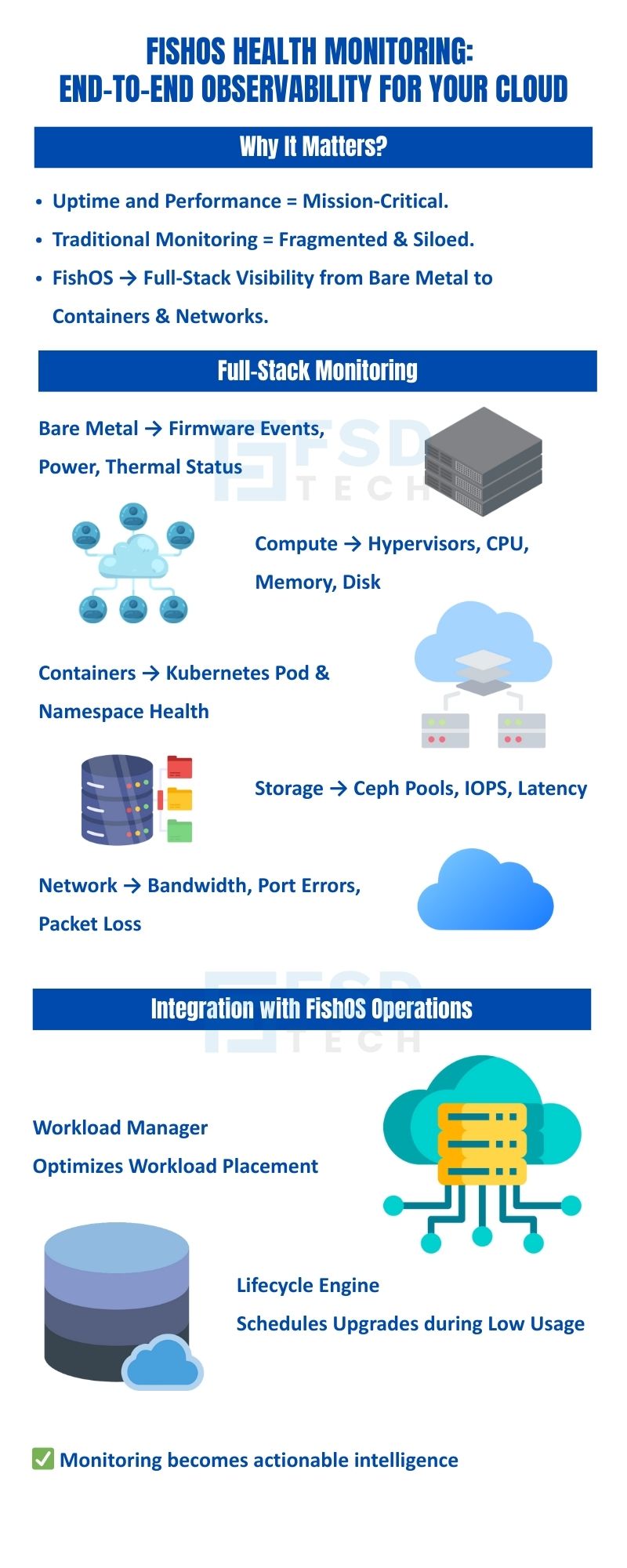
    Infographic on FishOS Health Monitoring showing why full-stack observability matters. Highlights monitoring from bare metal, compute, containers, storage, and network with integration into workload management and lifecycle scheduling. FSD Tech branding.

    FAQs

    What components does FishOS monitor?

    FishOS monitors bare metal, compute (hypervisors), containers, storage (Ceph), and networking.
     

    Is third-party monitoring required?

    No. FishOS provides built-in dashboards, alerts, and integrations. APIs are available for centralized observability if needed.


    Are dashboards and alerts customizable?

    Yes. Dashboards can be tailored to user roles, thresholds can be configured per SLA or workload type, and alerts can be escalated according to policies.


    Does telemetry influence workload placement or upgrades?

    Yes. Telemetry feeds directly into Workload Manager and Lifecycle Engine, enabling smarter placement and maintenance scheduling.


    Can telemetry data be stored long-term?

    Yes. Metrics and logs can be retained for audits, reporting, and trend analysis.

    FishOS Health Monitoring: Full Visibility Across Your Cloud Infrastructure

    About The Author

    Anas Abdu Rauf

    Anas is an Expert in Network and Security Infrastructure, With over seven years of industry experience, holding certifications Including CCIE- Enterprise, PCNSE, Cato SASE Expert, and Atera Certified Master. Anas provides his valuable insights and expertise to readers.

    TRY OUR PRODUCTS

    Like This Story?

    Share it with friends!

    Subscribe to our newsletter!

    FishOSCato SASEVembuXcitiumZeta HRMSAtera
    Isometric illustration of a centralized performance platform connected to analytics dashboards and team members, representing goal alignment, measurable outcomes, risk visibility, and strategic project tracking within ClickUp.

    How ClickUp Enables Outcome-Based Project Management (Not Just Task Tracking)

    🕓 February 15, 2026
    Isometric illustration of a centralized executive dashboard platform connected to analytics panels, performance charts, security indicators, and strategic milestones, representing real-time business visibility and decision control within ClickUp.

    Executive Visibility in ClickUp – How CXOs Gain Real-Time Control Without Micromanaging

    🕓 February 13, 2026

    Cato SASE Architecture

    Inside Cato’s SASE Architecture: A Blueprint for Modern Security

    🕓 January 26, 2025

    Workflow Automation(8)

    Workforce Automation(1)

    AI Project Management(1)

    HR Data Automation(1)

    RMM(2)

    IT Workflow Automation(1)

    GCC compliance(4)

    IT security(2)

    Payroll Integration(2)

    IT support automation(3)

    procurement automation(1)

    lost device management(1)

    IT Management(5)

    IoT Security(3)

    Cato XOps(1)

    IT compliance(5)

    Task Automation(1)

    Workflow Management(1)

    OpenStack automation(1)

    Kubernetes lifecycle management(2)

    AI-powered cloud ops(1)

    SMB Security(8)

    Data Security(1)

    MDR (Managed Detection & Response)(3)

    MSP Automation(3)

    Atera Integrations(2)

    XDR Security(2)

    Threat Detection & Response(1)

    Ransomware Defense(3)

    SMB Cyber Protection(1)

    HR Tech Solutions(1)

    Zero Trust Network Access(3)

    Quantum Threat UAE & GCC(1)

    Post-Quantum Cryptography(1)

    Quantum Security(1)

    Zero Trust Security(2)

    Cloud IDE Security(1)

    Endpoint Management(1)

    SaaS Security(2)

    Payroll Automation(5)

    IT Monitoring(2)

    Xcitium EDR SOC(15)

    Ransomware Protection GCC(1)

    Network Consolidation UAE(1)

    M&A IT Integration(1)

    MSSP for SMBs(1)

    Managed EDR FSD-Tech(1)

    FSD-Tech MSSP(25)

    Ransomware Protection(3)

    Antivirus vs EDR(1)

    SMB Cybersecurity GCC(1)

    Endpoint Security(1)

    Cybersecurity GCC(15)

    Data Breach Costs(1)

    Endpoint Protection(1)

    SMB Cybersecurity(8)

    Managed Security Services(2)

    Xcitium EDR(30)

    Zero Dwell Containment(31)

    Hybrid Backup(1)

    Cloud Backup(1)

    Backup & Recovery(1)

    pointguard ai(4)

    vembu(9)

    SMB data protection(9)

    disaster recovery myths(1)

    backup myths(1)

    Disaster Recovery(4)

    Vembu BDR Suite(19)

    DataProtection(1)

    GCCBusiness(1)

    Secure Access Service Edge(4)

    GCC IT Solutions(1)

    Unified Network Management(1)

    GCC HR software(20)

    open banking(1)

    CC compliance(1)

    financial cybersecurity(2)

    Miradore EMM(15)

    Government Security(1)

    Cato SASE(9)

    Cloud Security(9)

    GCC Education(1)

    Hybrid Learning(1)

    Talent Development(1)

    AI Governance(4)

    AI Compliance(2)

    AI Security(2)

    AI Cybersecurity(13)

    AI Risk Management(1)

    Secure Remote Access(1)

    GCC business security(1)

    GCC network integration(1)

    compliance automation(5)

    education security(1)

    GCC cybersecurity(3)

    BYOD security Dubai(8)

    App management UAE(1)

    Miradore EMM Premium+(5)

    MiddleEast(1)

    share your thoughts

    Isometric diagram showing Cato SASE troubleshooting workflow where device inventory, DHCP mapping, posture validation, and firewall event logs are analyzed to diagnose device-based rule enforcement issues.

    Troubleshooting Device-Based Firewall Rules in Cato SASE

    🕓 March 13, 2026

    Isometric diagram showing Cato SASE device inventory analyzing network traffic, DHCP data, and device attributes to support WAN and Internet firewall enforcement and device-aware security policies.

    Understanding Device Identification Limitations in Cato Device Inventory

    🕓 March 8, 2026

    Isometric diagram showing Cato SASE cloud analyzing network traffic, DHCP data, and MAC address fingerprints to identify devices and enable accurate device-based firewall enforcement.

    Why DHCP Configuration Matters for Device-Based Firewall Enforcement in Cato SASE

    🕓 March 7, 2026

    Decoded(172)

    Cyber Security(128)

    BCP / DR(22)

    Zeta HRMS(78)

    SASE(21)

    Automation(78)

    Next Gen IT-Infra(128)

    Monitoring & Management(80)

    ITSM(22)

    HRMS(21)

    Automation(24)