HomeNext Gen IT-InfraMonitoring & ManagementCyber SecurityBCP / DRAutomationDecoded
Next Gen IT-Infra
Cato’s SASE Supports Cybersecurity Skills Development

How Cato’s SASE Supports Cybersecurity Skills Development

🕓 April 8, 2025

How SASE Supports the Security Needs of SMBs

How SASE Supports the Security Needs of SMBs

🕓 February 9, 2025

Attack Surface Reduction with Cato’s SASE

Attack Surface Reduction with Cato’s SASE

🕓 February 10, 2025

SASE for Digital Transformation in UAE

SASE for Digital Transformation in UAE

🕓 February 8, 2025

Monitoring & Management
Understanding Atera’s SLA Management

Understanding Atera’s SLA Management

🕓 February 7, 2025

Cost-Performance Ratio: Finding the Right Balance in IT Management Networks

Cost-Performance Ratio: Finding the Right Balance in IT Management Networks

🕓 June 16, 2025

Customizing Atera with APIs

Customizing Atera with APIs

🕓 March 3, 2025

Power Up Your IT Team’s Strategy with Atera’s Communication Tools

Power Up Your IT Team’s Strategy with Atera’s Communication Tools

🕓 February 8, 2025

Cyber Security
Illustration of the Cato Cloud architecture showing its role in delivering SASE for secure, optimized global connectivity.

Understanding the Cato Cloud and Its Role in SASE

🕓 January 29, 2025

Isometric illustration of professionals managing network performance, bandwidth analytics, and cloud-based optimization around the Cato Networks platform, symbolizing bandwidth control and QoS visibility.

Mastering Bandwidth Control and QoS in Cato Networks

🕓 July 26, 2025

Global network backbone powering Cato SASE solution for secure, high-performance connectivity across regions.

Global Backbone: The Engine Powering Cato’s SASE Solution

🕓 January 30, 2025

Illustration of team analyzing application traffic and usage insights on a large laptop screen using Cato’s dashboard, surrounded by network and cloud icons.

Cato Networks Application Visibility | Monitoring & Control

🕓 July 27, 2025

BCP / DR
Illustration showing diverse business and IT professionals collaborating with cloud, backup, and security icons, representing Vembu use cases for SMBs, MSPs, and IT teams.

Who Uses Vembu? Real-World Use Cases for SMBs, MSPs & IT Teams

🕓 July 12, 2025

Graphic showcasing Vembu’s all-in-one backup and disaster recovery platform with icons for cloud, data protection, and business continuity for IT teams and SMBs.

What Is Vembu? A Deep Dive Into the All in One Backup & Disaster Recovery Platform

🕓 July 6, 2025

Illustration showing Vembu backup and disaster recovery system with cloud storage, server racks, analytics dashboard, and IT professionals managing data.

The Rising Cost of Data Loss: Why Backup Is No Longer Optional?

🕓 August 14, 2025

3D isometric illustration of cloud backup and data recovery infrastructure with laptop, data center stack, and digital business icons — FSD Tech

RPO & RTO: The Heart of Business Continuity

🕓 August 15, 2025

Automation
Cross-Functional Collaboration with ClickUp

Fostering Cross-Functional Collaboration with ClickUp for Multi-Departmental Projects

🕓 February 11, 2025

ClickUp Project Reporting

Revolutionizing Enterprise Reporting with ClickUp’s Advanced Analytics and Dashboards

🕓 June 16, 2025

ClickUp’s Design Collaboration and Asset Management Tools

Empowering Creative Teams with ClickUp’s Design Collaboration and Asset Management Tools

🕓 February 26, 2025

ClickUp Communication and Collaboration Tools

ClickUp Communication and Collaboration Tools: Empowering Remote Teams

🕓 March 12, 2025

Decoded
Multi-Factor Authentication (MFA)

Multi-Factor Authentication (MFA): All You Need to Know

🕓 December 7, 2025

L3 Switch

What Is an L3 Switch? L2 vs L3 & Why You Need Layer 3?

🕓 December 8, 2025

IPSec

IPSec Explained: Protocols, Modes, IKE & VPN Security

🕓 December 3, 2025

 Datagram Transport Layer Security (DTLS)

What is Datagram Transport Layer Security (DTLS)? How it works?

🕓 December 4, 2025

    Subscribe to our newsletter!

    About Us

    Follow Us

    Copyright © 2024 | Powered by 

    Atera

    (57)

    Cato Networks

    (131)

    ClickUp

    (78)

    FishOS

    (7)

    Miradore

    (21)

    PointGuard AI

    (9)

    Vembu

    (22)

    Xcitium

    (33)

    ZETA HRMS

    (79)

    Table of Contents

    Cloud-Native Architecture: Why SASE is the Future of Global Networking?

    Surbhi Suhane
    March 19, 2026
    Comments
    Cloud-Native Architecture

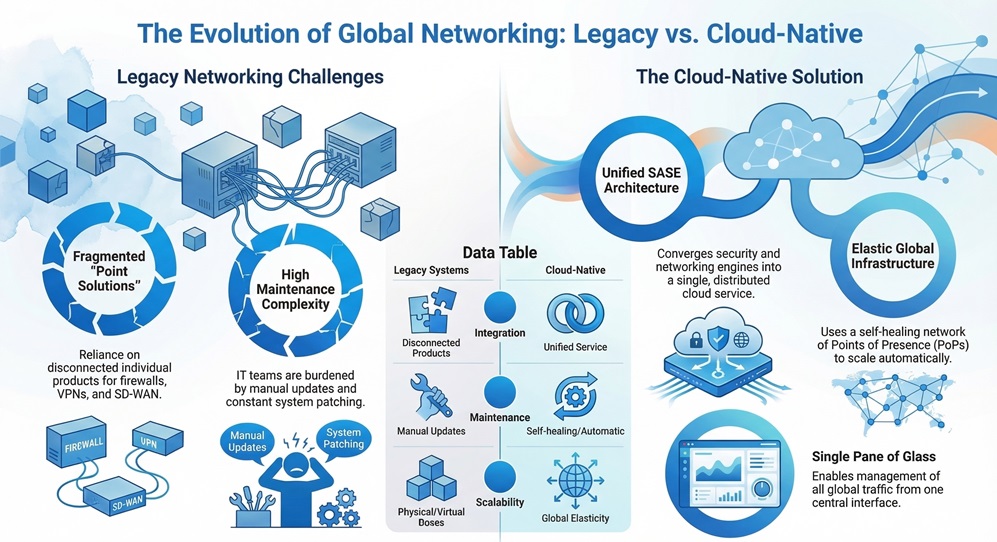
    Cloud-Native Architecture isn't just about moving your server to the cloud. To be honest, it represents a complete shift in how we build, secure, and manage global networks. In my experience, many IT teams still struggle with "point solutions"—a messy pile of individual products for firewalls, VPNs, and SD-WAN that were never meant to work together.


    But what if you could ditch that complexity? Picture this: a world where your network and security live entirely in a distributed cloud service, scaling automatically as your business grows. We've all been there, trying to patch old systems while users complain about slow speeds. Here's the thing: a cloud-native approach changes the game by converging these functions into one unified service.


    What is Cloud-Native Architecture in Networking?

    The term Cloud-Native Architecture refers to a system built from the ground up to live in the cloud. Unlike legacy systems that were later "virtualized" or stuck in a box, a true cloud-native platform uses a global network of Points of Presence (PoPs). This design allows the system to be elastic, self-healing, and easy to maintain without constant manual updates.


    Cloud-Native Architecture


    In the world of SASE (Secure Access Service Edge), being cloud-native means all your security and networking engines run in a distributed cloud. It's roughly like having a giant, secure router that exists everywhere at once, allowing you to manage global traffic from a single pane of glass.


    Switch to Cato SASE Today


    The Core Pillars of SASE

    Gartner defined SASE in 2019 to solve a specific problem: the death of the "datacenter perimeter". Today, your data is in the cloud, and your users are working from home. A Cloud-Native Architecture supports four main attributes:


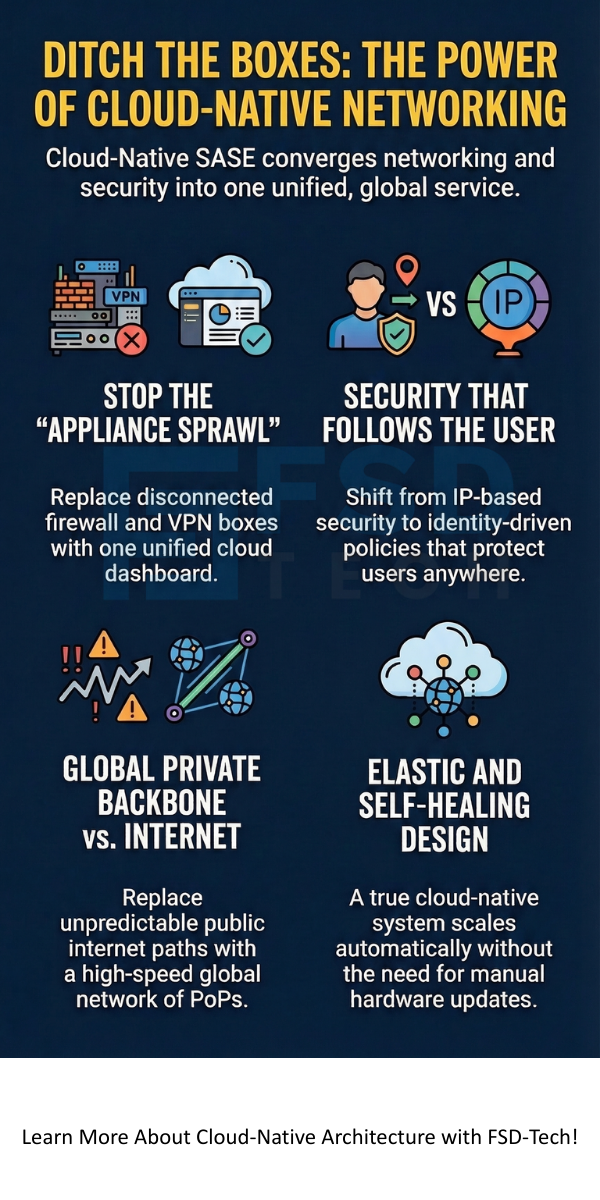
    • Identity-driven: Policies follow the user and the resource, not just an IP address, which cuts down on manual work.
    • Cloud-native: All heavy lifting happens in the cloud, meaning you only need simple hardware at your physical sites.
    • Supports All Edges: It creates one secure fabric for branches, mobile users, and cloud data centers alike.
    • Globally Distributed: It uses a network of PoPs so that users always connect to the closest point for the best performance.


    Is your current network still forcing all traffic back to a central office? That old "trombone effect" adds massive lag and frustrates your team.


    Why Move Away from Point Solutions?

    Historically, we solved every new problem with a new box. Need a firewall? Buy a box. Need SD-WAN? Buy another box. This led to "appliance sprawl," which is expensive, hard to manage, and creates blind spots in your security.


    A Cloud-Native Architecture converges these point solutions into one service. This means you manage everything—from your NGFW (Next-Generation Firewall) to your ZTNA (Zero-Trust Network Access)—through a single dashboard. To be honest, it stops your IT team from agonizing over integration and lets them move the business forward.


    Also Read: Segmenting IoT and OT Devices Using Cato WAN and Internet Firewalls


    Real-World Impact: Industry Examples

    Let's look at how this works in practice. In manufacturing, the shift to Industry 4.0 has introduced thousands of IoT sensors. These devices often lack built-in security, leaving them exposed. By using a cloud-native SASE platform, a manufacturer can instantly secure all those sensors without installing hardware at every factory.


    Retailers face similar hurdles. They need to process credit cards securely at hundreds of locations while providing guest Wi-Fi. A Cloud-Native Architecture allows them to deploy simple "sockets" that connect to the cloud, where high-end security like DLP (Data Loss Prevention) is applied automatically.


    Key Components of a Modern Platform

    A true cloud-native SASE platform, like the one offered by Cato Networks, includes several integrated parts:


    1. Global Private Backbone: A network of PoPs connected by high-speed links to replace unpredictable internet paths.
    2. Edge Connectivity: Simple hardware or software (SD-WAN appliances or mobile clients) to get you onto the backbone.
    3. Security-as-a-Service: A full stack including SWG (Secure Web Gateway), CASB, and advanced threat prevention.


    Have you ever wondered why your global video calls drop? It's often because the public internet can't guarantee performance. A private backbone solves this by optimizing the "middle mile".


    Is Your Business Ready?

    Transitioning to a Cloud-Native Architecture doesn't have to happen overnight. Many companies start with one "entry point," like replacing a legacy VPN or migrating from MPLS to SD-WAN.

    The beauty of the cloud is its flexibility. You can start small and scale as you see the benefits. Plus, you'll finally give your IT team their time back so they can focus on strategic goals instead of troubleshooting old boxes.


    Conclusion

    The shift toward Cloud-Native Architecture is inevitable for any business that wants to stay agile. By moving away from rigid, appliance-based networks, you gain the freedom to support a global workforce without the "sweat and tears" of manual integration. At the end of the day, our focus is on making your digital transformation seamless and secure. We're committed to your success and ready to help you navigate whatever comes next.


    Cloud-Native Architecture


    Speak with a Cloud Expert


    Key Takeaways

    • Cloud-native means built for the cloud, offering elasticity and self-healing.
    • SASE converges networking and security into a single global service.
    • Identity-driven policies ensure security follows users regardless of their location.
    • Eliminating point solutions reduces costs and management complexity.
    • A global private backbone provides better performance than the public internet.


    Frequently Asked Questions

    What is the difference between SASE and SD-WAN?

    SD-WAN is just one piece of SASE. While SD-WAN focuses on connecting locations, SASE adds a full layer of cloud-native security and supports mobile users in one fabric.


    Do I still need a separate firewall?

    In a cloud-native SASE model, the firewall is delivered as a service (FWaaS) from the cloud. You no longer need to maintain physical firewall appliances at every site.


    Is cloud-native more secure than on-premises?

    Yes, because it provides total visibility and eliminates blind spots. Security updates are applied once in the cloud and instantly protect every user and location globally.

    Cloud-Native Architecture: Why SASE is the Future of Global Networking?

    About The Author

    Surbhi Suhane

    Surbhi Suhane is an experienced digital marketing and content specialist with deep expertise in Getting Things Done (GTD) methodology and process automation. Adept at optimizing workflows and leveraging automation tools to enhance productivity and deliver impactful results in content creation and SEO optimization.

    TRY OUR PRODUCTS

    Like This Story?

    Share it with friends!

    Subscribe to our newsletter!

    FishOSCato SASEVembuXcitiumZeta HRMSAtera
    Isometric illustration of a centralized performance platform connected to analytics dashboards and team members, representing goal alignment, measurable outcomes, risk visibility, and strategic project tracking within ClickUp.

    How ClickUp Enables Outcome-Based Project Management (Not Just Task Tracking)

    🕓 February 15, 2026
    Isometric illustration of a centralized executive dashboard platform connected to analytics panels, performance charts, security indicators, and strategic milestones, representing real-time business visibility and decision control within ClickUp.

    Executive Visibility in ClickUp – How CXOs Gain Real-Time Control Without Micromanaging

    🕓 February 13, 2026

    Cato SASE Architecture

    Inside Cato’s SASE Architecture: A Blueprint for Modern Security

    🕓 January 26, 2025

    Workflow Automation(8)

    Workforce Automation(1)

    AI Project Management(1)

    HR Data Automation(1)

    RMM(2)

    IT Workflow Automation(1)

    GCC compliance(4)

    IT security(2)

    Payroll Integration(2)

    IT support automation(3)

    procurement automation(1)

    lost device management(1)

    IT Management(5)

    IoT Security(2)

    Cato XOps(1)

    IT compliance(4)

    Task Automation(1)

    Workflow Management(1)

    Kubernetes lifecycle management(2)

    AI-powered cloud ops(1)

    OpenStack automation(1)

    SMB Security(8)

    Data Security(1)

    MDR (Managed Detection & Response)(3)

    MSP Automation(3)

    Atera Integrations(2)

    Threat Detection & Response(1)

    XDR Security(2)

    SMB Cyber Protection(1)

    Ransomware Defense(3)

    HR Tech Solutions(1)

    Zero Trust Network Access(3)

    Quantum Security(1)

    Quantum Threat UAE & GCC(1)

    Post-Quantum Cryptography(1)

    Cloud IDE Security(1)

    Zero Trust Security(2)

    Endpoint Management(1)

    SaaS Security(2)

    Payroll Automation(5)

    IT Monitoring(2)

    Xcitium EDR SOC(15)

    Ransomware Protection GCC(1)

    Network Consolidation UAE(1)

    M&A IT Integration(1)

    MSSP for SMBs(1)

    Antivirus vs EDR(1)

    SMB Cybersecurity GCC(1)

    Ransomware Protection(3)

    Managed EDR FSD-Tech(1)

    FSD-Tech MSSP(25)

    Endpoint Security(1)

    Cybersecurity GCC(14)

    Data Breach Costs(1)

    Endpoint Protection(1)

    SMB Cybersecurity(8)

    Zero Dwell Containment(31)

    Xcitium EDR(30)

    Managed Security Services(2)

    Hybrid Backup(1)

    Cloud Backup(1)

    Backup & Recovery(1)

    pointguard ai(4)

    vembu(9)

    backup myths(1)

    SMB data protection(9)

    disaster recovery myths(1)

    Disaster Recovery(4)

    Vembu BDR Suite(19)

    GCCBusiness(1)

    DataProtection(1)

    Secure Access Service Edge(4)

    GCC IT Solutions(1)

    Unified Network Management(1)

    GCC HR software(20)

    open banking(1)

    financial cybersecurity(2)

    CC compliance(1)

    Miradore EMM(15)

    Government Security(1)

    Cato SASE(9)

    GCC Education(1)

    Hybrid Learning(1)

    Cloud Security(9)

    Talent Development(1)

    AI Governance(4)

    AI Compliance(2)

    AI Cybersecurity(13)

    AI Risk Management(1)

    AI Security(2)

    Secure Remote Access(1)

    GCC business security(1)

    GCC network integration(1)

    compliance automation(5)

    GCC cybersecurity(3)

    education security(1)

    App management UAE(1)

    BYOD security Dubai(8)

    Miradore EMM Premium+(5)

    MiddleEast(1)

    share your thoughts

    SASE Point of Presence (PoP)

    SASE Point of Presence (PoP): The Heart of Cloud-Native Networking

    🕓 March 19, 2026

    Cloud-Native Architecture

    Cloud-Native Architecture: Why SASE is the Future of Global Networking?

    🕓 March 19, 2026

    Maximum Transmission Unit

    Maximum Transmission Unit: MTU Settings for Faster Networks

    🕓 March 18, 2026

    Decoded(164)

    Cyber Security(128)

    BCP / DR(22)

    Zeta HRMS(78)

    SASE(21)

    Automation(78)

    Next Gen IT-Infra(128)

    Monitoring & Management(78)

    ITSM(22)

    HRMS(21)

    Automation(24)