HomeNext Gen IT-InfraMonitoring & ManagementCyber SecurityBCP / DRAutomationDecoded
Next Gen IT-Infra
Cato’s SASE Supports Cybersecurity Skills Development

How Cato’s SASE Supports Cybersecurity Skills Development

🕓 April 8, 2025

How SASE Supports the Security Needs of SMBs

How SASE Supports the Security Needs of SMBs

🕓 February 9, 2025

Attack Surface Reduction with Cato’s SASE

Attack Surface Reduction with Cato’s SASE

🕓 February 10, 2025

SASE for Digital Transformation in UAE

SASE for Digital Transformation in UAE

🕓 February 8, 2025

Monitoring & Management
Understanding Atera’s SLA Management

Understanding Atera’s SLA Management

🕓 February 7, 2025

Cost-Performance Ratio: Finding the Right Balance in IT Management Networks

Cost-Performance Ratio: Finding the Right Balance in IT Management Networks

🕓 June 16, 2025

Customizing Atera with APIs

Customizing Atera with APIs

🕓 March 3, 2025

Power Up Your IT Team’s Strategy with Atera’s Communication Tools

Power Up Your IT Team’s Strategy with Atera’s Communication Tools

🕓 February 8, 2025

Cyber Security
Illustration of the Cato Cloud architecture showing its role in delivering SASE for secure, optimized global connectivity.

Understanding the Cato Cloud and Its Role in SASE

🕓 January 29, 2025

Isometric illustration of professionals managing network performance, bandwidth analytics, and cloud-based optimization around the Cato Networks platform, symbolizing bandwidth control and QoS visibility.

Mastering Bandwidth Control and QoS in Cato Networks

🕓 July 26, 2025

Global network backbone powering Cato SASE solution for secure, high-performance connectivity across regions.

Global Backbone: The Engine Powering Cato’s SASE Solution

🕓 January 30, 2025

Illustration of team analyzing application traffic and usage insights on a large laptop screen using Cato’s dashboard, surrounded by network and cloud icons.

Cato Networks Application Visibility | Monitoring & Control

🕓 July 27, 2025

BCP / DR
Illustration showing diverse business and IT professionals collaborating with cloud, backup, and security icons, representing Vembu use cases for SMBs, MSPs, and IT teams.

Who Uses Vembu? Real-World Use Cases for SMBs, MSPs & IT Teams

🕓 July 12, 2025

Graphic showcasing Vembu’s all-in-one backup and disaster recovery platform with icons for cloud, data protection, and business continuity for IT teams and SMBs.

What Is Vembu? A Deep Dive Into the All in One Backup & Disaster Recovery Platform

🕓 July 6, 2025

Illustration showing Vembu backup and disaster recovery system with cloud storage, server racks, analytics dashboard, and IT professionals managing data.

The Rising Cost of Data Loss: Why Backup Is No Longer Optional?

🕓 August 14, 2025

3D isometric illustration of cloud backup and data recovery infrastructure with laptop, data center stack, and digital business icons — FSD Tech

RPO & RTO: The Heart of Business Continuity

🕓 August 15, 2025

Automation
Cross-Functional Collaboration with ClickUp

Fostering Cross-Functional Collaboration with ClickUp for Multi-Departmental Projects

🕓 February 11, 2025

ClickUp Project Reporting

Revolutionizing Enterprise Reporting with ClickUp’s Advanced Analytics and Dashboards

🕓 June 16, 2025

ClickUp’s Design Collaboration and Asset Management Tools

Empowering Creative Teams with ClickUp’s Design Collaboration and Asset Management Tools

🕓 February 26, 2025

ClickUp Communication and Collaboration Tools

ClickUp Communication and Collaboration Tools: Empowering Remote Teams

🕓 March 12, 2025

Decoded
Multi-Factor Authentication (MFA)

Multi-Factor Authentication (MFA): All You Need to Know

🕓 December 7, 2025

L3 Switch

What Is an L3 Switch? L2 vs L3 & Why You Need Layer 3?

🕓 December 8, 2025

IPSec

IPSec Explained: Protocols, Modes, IKE & VPN Security

🕓 December 3, 2025

 Datagram Transport Layer Security (DTLS)

What is Datagram Transport Layer Security (DTLS)? How it works?

🕓 December 4, 2025

    Subscribe to our newsletter!

    About Us

    Follow Us

    Copyright © 2024 | Powered by 

    Atera

    (56)

    Cato Networks

    (129)

    ClickUp

    (78)

    FishOS

    (7)

    Miradore

    (21)

    PointGuard AI

    (9)

    Vembu

    (22)

    Xcitium

    (33)

    ZETA HRMS

    (79)

    Table of Contents

    What is Antibot? Stopping Automated Threats

    Surbhi Suhane
    March 10, 2026
    Comments
    Antibot

    What is Antibot and Why Does Your Business Need It?

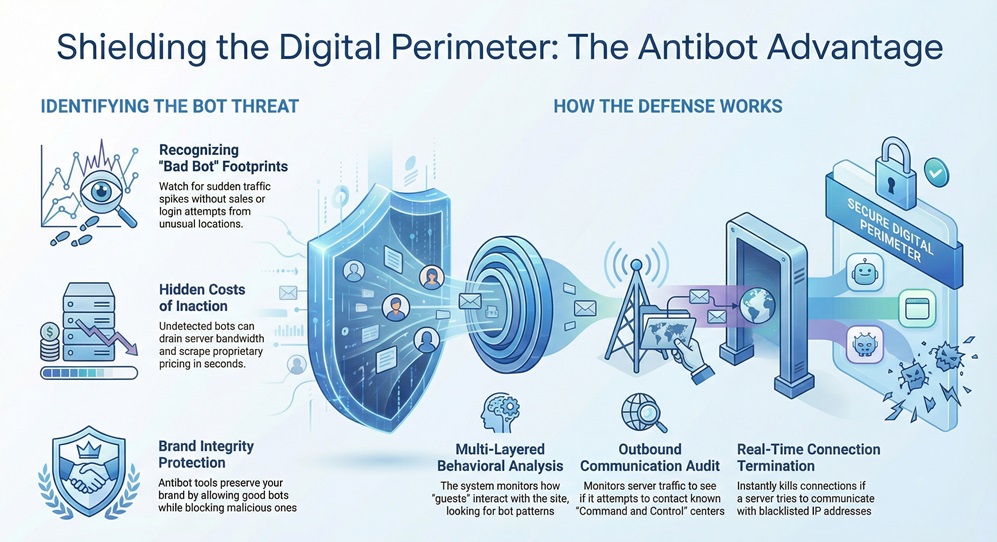
    Antibot technology acts as your first line of defense against the silent, automated scripts that crawl the web to steal data or disrupt services. Have you ever wondered why your website traffic spikes suddenly, but your sales stay the same? Or perhaps you've noticed strange login attempts from countries where you don't even have customers. These are often the footprints of "bad bots."


    In my experience working with network security, I've seen how a single undetected bot can drain bandwidth and scrape proprietary pricing in seconds. It’s a game of cat and mouse. While some bots help search engines find you, others work for hackers. An antibot solution helps you tell the difference. It isn't just about blocking traffic; it's about protecting your brand's integrity.


    How Antibot Solutions Work in Real-Time?

    An antibot system uses a multi-layered approach to catch malicious scripts. Think of it like a smart security guard at a private club. The guard doesn't just look at a guest's ID; they watch how the guest walks, talks, and interacts with others.


    Antibot infographic


    According to technical documents from leaders like Check Point, these tools look for specific "bot patterns." They monitor outbound communication from your servers to see if they're trying to talk to known "Command and Control" (C&C) centers. If your server suddenly tries to send a packet of data to a blacklisted IP address in the middle of the night, the antibot software steps in to kill the connection.


    Secure Your Network Now


    The Role of Post-Infection Detection

    Wait, why do we need to detect infections after they happen? To be honest, no firewall is 100% foolproof. Sometimes a user accidentally clicks a phishing link, and a bot gets inside your perimeter. This is where antibot tools shine. They provide "post-infection" visibility.


    By analyzing the DNA of the traffic, the software identifies infected hosts within your network. It looks for "phone home" attempts. Once it finds an infected device, it blocks the outgoing data. This prevents the bot from "reporting back" to its master, effectively neutralizing the threat even if the malware is already on the machine.


    Why Traditional Firewalls Aren't Enough?

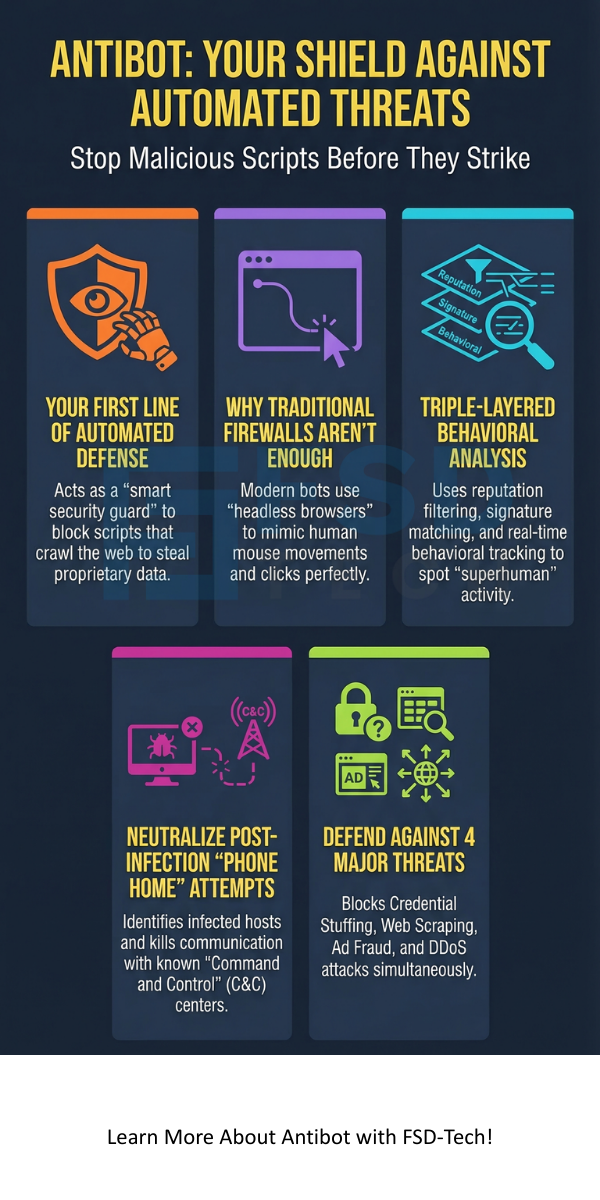
    You might think your standard firewall is enough. However, bots have become incredibly sophisticated. Modern automated threats use "headless browsers" that mimic human behavior perfectly. They can move the mouse, click buttons, and even solve simple puzzles.


    Standard security often looks at "what" the traffic is. An antibot solution looks at "how" the traffic behaves. It uses a massive database of bot fingerprints. These fingerprints are updated constantly. If a new bot strain appears in Europe, your system in New York knows about it within minutes. This global intelligence is the "secret sauce" of modern cybersecurity.


    Also Read: Network Firewalls vs. Next-Generation Firewalls: Which One Wins?


    Common Automated Threats You Face

    • Credential Stuffing: Bots use leaked passwords to try and break into user accounts.
    • Web Scraping: Competitors use scripts to steal your prices or unique content.
    • Ad Fraud: Automated scripts click on your paid ads, wasting your marketing budget.
    • DDoS Attacks: Distributed Denial of Service attacks use botnets to crash your website.


    Implementing Antibot in Virtual Environments

    As businesses move to the cloud, the "virtual" landscape changes the rules. When you run servers in a virtual environment, you need an antibot solution that can scale. Check Point’s research highlights that virtual security must be as agile as the virtual machines themselves.


    In these setups, the antibot software usually sits at the virtual gateway. It inspects traffic between virtual machines (East-West traffic) and traffic leaving the cloud (North-South traffic). This prevents a bot from jumping from one virtual server to another. If one "pod" gets hit, the rest of your cloud stays safe.


    The Evolution of Bot Detection Techniques

    How do we actually spot a bot in a sea of millions of users? It's not as easy as it sounds. We use several layers of analysis to make a decision.


    1. Reputation-Based Filtering

    This is the simplest form. The system maintains a list of known "bad" IP addresses. If a request comes from a server known for hosting malware, the antibot blocks it immediately. It’s effective, but it only catches the "dumb" bots.


    2. Signature Matching

    Every bot has a "signature" or a specific bit of code that gives it away. Security researchers analyze malware samples and create these signatures. When the traffic matches a signature in the database, the alarm goes off.


    3. Behavioral Analysis

    This is my favorite part. Behavioral analysis doesn't care what the bot looks like; it cares what it does. For example, a human takes about 1-2 seconds to read a headline before clicking. A bot clicks the next link in 0.001 seconds. When the antibot sees this "superhuman" speed, it knows it's dealing with a script.


    Also Read: What is Unified Endpoint Management and Why Does Your Team Need It?


    Is Antibot Protection Hard to Manage?

    Here is the thing: many small business owners fear that high-level security will slow down their website. In reality, modern antibot tools are designed to be "invisible." They use low-latency inspection. This means they check the traffic so fast that your real customers never notice a delay.


    In my view, the risk of not having protection is much higher. Think about the cost of a data breach. If a bot steals your customer database, the legal fees and loss of trust could ruin you. We've all been there—trying to save a few dollars on tools only to pay ten times more later to fix a mess.


    Antibot Management and Reporting

    A good tool should tell you exactly what it's doing. You shouldn't need a PhD in computer science to read the reports. Most platforms provide a dashboard that shows:


    • How many bots were blocked today?
    • Which servers are currently infected?
    • Where is the "Command and Control" traffic trying to go?


    This visibility allows your IT team to focus on the real problems instead of chasing shadows. Instead of wondering "why is the server slow?", you can see that an antibot just stopped a massive scraping attempt.


    Conclusion

    The digital world is full of automated noise. To keep your business running smoothly, you need a way to filter out the malicious scripts while letting the real people in. Antibot protection isn't just a "nice-to-have" anymore; it's a fundamental part of staying online.


    At FSD-Tech, we believe that security should empower your business, not slow it down. We focus on providing solutions that are easy to use and incredibly effective. Don't wait for a bot to crash your site or steal your data. Take a proactive step toward a safer digital future today.


    Talk to a Bot Specialist

    Key Takeaways

    • Antibot technology detects and blocks malicious automated scripts in real-time.
    • It provides "post-infection" security by stopping bots from communicating with their creators.
    • Multi-layered defense includes reputation, signatures, and behavioral analysis.
    • Virtual environments require specialized, scalable bot protection.
    • Using these tools saves bandwidth and protects your brand reputation from data theft.


    Frequently Asked Questions (FAQs)

    Will an antibot block Google's search engine bots?

    No. Sophisticated tools have a "whitelist" for good bots like Googlebot or Bingbot. This ensures your SEO rankings aren't affected while bad actors are kept out.


    Is antibot the same as an Antivirus?

    Not exactly. An Antivirus looks for files on your computer. An antibot looks at the communication patterns and traffic flow to identify bot-like behavior.


    Do I need this if I have a small website?

    Yes. Bots don't care about the size of your business. They look for vulnerabilities. In fact, smaller sites are often easier targets because they have weaker security.


    How does it handle encrypted (HTTPS) traffic?

    Most modern solutions can decrypt and inspect traffic (with proper certificates) to ensure no bots are hiding inside encrypted packets.

    What is Antibot? Stopping Automated Threats

    About The Author

    Surbhi Suhane

    Surbhi Suhane is an experienced digital marketing and content specialist with deep expertise in Getting Things Done (GTD) methodology and process automation. Adept at optimizing workflows and leveraging automation tools to enhance productivity and deliver impactful results in content creation and SEO optimization.

    TRY OUR PRODUCTS

    Like This Story?

    Share it with friends!

    Subscribe to our newsletter!

    FishOSCato SASEVembuXcitiumZeta HRMSAtera
    Isometric illustration of a centralized performance platform connected to analytics dashboards and team members, representing goal alignment, measurable outcomes, risk visibility, and strategic project tracking within ClickUp.

    How ClickUp Enables Outcome-Based Project Management (Not Just Task Tracking)

    🕓 February 15, 2026
    Isometric illustration of a centralized executive dashboard platform connected to analytics panels, performance charts, security indicators, and strategic milestones, representing real-time business visibility and decision control within ClickUp.

    Executive Visibility in ClickUp – How CXOs Gain Real-Time Control Without Micromanaging

    🕓 February 13, 2026

    Cato SASE Architecture

    Inside Cato’s SASE Architecture: A Blueprint for Modern Security

    🕓 January 26, 2025

    Workflow Automation(8)

    Workforce Automation(1)

    AI Project Management(1)

    HR Data Automation(1)

    RMM(2)

    IT Workflow Automation(1)

    IT security(2)

    GCC compliance(4)

    Payroll Integration(2)

    IT support automation(3)

    procurement automation(1)

    lost device management(1)

    IT Management(5)

    IoT Security(2)

    Cato XOps(1)

    IT compliance(4)

    Workflow Management(1)

    Task Automation(1)

    Kubernetes lifecycle management(2)

    AI-powered cloud ops(1)

    OpenStack automation(1)

    SMB Security(8)

    Data Security(1)

    MDR (Managed Detection & Response)(3)

    MSP Automation(3)

    Atera Integrations(2)

    XDR Security(2)

    Threat Detection & Response(1)

    Ransomware Defense(3)

    SMB Cyber Protection(1)

    HR Tech Solutions(1)

    Zero Trust Network Access(3)

    Post-Quantum Cryptography(1)

    Quantum Threat UAE & GCC(1)

    Quantum Security(1)

    Cloud IDE Security(1)

    Zero Trust Security(2)

    Endpoint Management(1)

    SaaS Security(2)

    Payroll Automation(5)

    IT Monitoring(2)

    Xcitium EDR SOC(15)

    Ransomware Protection GCC(1)

    M&A IT Integration(1)

    Network Consolidation UAE(1)

    MSSP for SMBs(1)

    Antivirus vs EDR(1)

    Managed EDR FSD-Tech(1)

    Ransomware Protection(3)

    SMB Cybersecurity GCC(1)

    FSD-Tech MSSP(25)

    Endpoint Security(1)

    Cybersecurity GCC(13)

    Data Breach Costs(1)

    Endpoint Protection(1)

    SMB Cybersecurity(8)

    Xcitium EDR(30)

    Zero Dwell Containment(31)

    Managed Security Services(2)

    Cloud Backup(1)

    Hybrid Backup(1)

    Backup & Recovery(1)

    pointguard ai(4)

    vembu(9)

    SMB data protection(9)

    backup myths(1)

    disaster recovery myths(1)

    Disaster Recovery(4)

    Vembu BDR Suite(19)

    DataProtection(1)

    GCCBusiness(1)

    Secure Access Service Edge(4)

    GCC IT Solutions(1)

    Unified Network Management(1)

    GCC HR software(20)

    open banking(1)

    financial cybersecurity(2)

    CC compliance(1)

    Miradore EMM(15)

    Government Security(1)

    Cato SASE(9)

    GCC Education(1)

    Cloud Security(9)

    Hybrid Learning(1)

    Talent Development(1)

    AI Governance(4)

    AI Cybersecurity(13)

    AI Compliance(2)

    AI Security(2)

    AI Risk Management(1)

    Secure Remote Access(1)

    GCC business security(1)

    GCC network integration(1)

    compliance automation(5)

    education security(1)

    GCC cybersecurity(3)

    App management UAE(1)

    BYOD security Dubai(8)

    Miradore EMM Premium+(5)

    HealthcareSecurity(1)

    share your thoughts

    Antibot

    What is Antibot? Stopping Automated Threats

    🕓 March 10, 2026

    Network Firewalls vs. Next-Generation Firewalls:

    Network Firewalls vs. Next-Generation Firewalls: Which One Wins?

    🕓 March 10, 2026

    Managed Detection and Response (MDR)

    What is Managed Detection and Response (MDR)?

    🕓 March 9, 2026

    Decoded(148)

    Cyber Security(126)

    BCP / DR(22)

    Zeta HRMS(78)

    SASE(21)

    Automation(78)

    Next Gen IT-Infra(126)

    Monitoring & Management(77)

    ITSM(22)

    HRMS(21)

    Automation(24)