HomeNext Gen IT-InfraMonitoring & ManagementCyber SecurityBCP / DRAutomationDecoded
Next Gen IT-Infra
Cato’s SASE Supports Cybersecurity Skills Development

How Cato’s SASE Supports Cybersecurity Skills Development

🕓 April 8, 2025

How SASE Supports the Security Needs of SMBs

How SASE Supports the Security Needs of SMBs

🕓 February 9, 2025

Attack Surface Reduction with Cato’s SASE

Attack Surface Reduction with Cato’s SASE

🕓 February 10, 2025

SASE for Digital Transformation in UAE

SASE for Digital Transformation in UAE

🕓 February 8, 2025

Monitoring & Management
Understanding Atera’s SLA Management

Understanding Atera’s SLA Management

🕓 February 7, 2025

Cost-Performance Ratio: Finding the Right Balance in IT Management Networks

Cost-Performance Ratio: Finding the Right Balance in IT Management Networks

🕓 June 16, 2025

Customizing Atera with APIs

Customizing Atera with APIs

🕓 March 3, 2025

Power Up Your IT Team’s Strategy with Atera’s Communication Tools

Power Up Your IT Team’s Strategy with Atera’s Communication Tools

🕓 February 8, 2025

Cyber Security
Illustration of the Cato Cloud architecture showing its role in delivering SASE for secure, optimized global connectivity.

Understanding the Cato Cloud and Its Role in SASE

🕓 January 29, 2025

Isometric illustration of professionals managing network performance, bandwidth analytics, and cloud-based optimization around the Cato Networks platform, symbolizing bandwidth control and QoS visibility.

Mastering Bandwidth Control and QoS in Cato Networks

🕓 July 26, 2025

Global network backbone powering Cato SASE solution for secure, high-performance connectivity across regions.

Global Backbone: The Engine Powering Cato’s SASE Solution

🕓 January 30, 2025

Illustration of team analyzing application traffic and usage insights on a large laptop screen using Cato’s dashboard, surrounded by network and cloud icons.

Cato Networks Application Visibility | Monitoring & Control

🕓 July 27, 2025

BCP / DR
Illustration showing diverse business and IT professionals collaborating with cloud, backup, and security icons, representing Vembu use cases for SMBs, MSPs, and IT teams.

Who Uses Vembu? Real-World Use Cases for SMBs, MSPs & IT Teams

🕓 July 12, 2025

Graphic showcasing Vembu’s all-in-one backup and disaster recovery platform with icons for cloud, data protection, and business continuity for IT teams and SMBs.

What Is Vembu? A Deep Dive Into the All in One Backup & Disaster Recovery Platform

🕓 July 6, 2025

Illustration showing Vembu backup and disaster recovery system with cloud storage, server racks, analytics dashboard, and IT professionals managing data.

The Rising Cost of Data Loss: Why Backup Is No Longer Optional?

🕓 August 14, 2025

3D isometric illustration of cloud backup and data recovery infrastructure with laptop, data center stack, and digital business icons — FSD Tech

RPO & RTO: The Heart of Business Continuity

🕓 August 15, 2025

Automation
Cross-Functional Collaboration with ClickUp

Fostering Cross-Functional Collaboration with ClickUp for Multi-Departmental Projects

🕓 February 11, 2025

ClickUp Project Reporting

Revolutionizing Enterprise Reporting with ClickUp’s Advanced Analytics and Dashboards

🕓 June 16, 2025

ClickUp’s Design Collaboration and Asset Management Tools

Empowering Creative Teams with ClickUp’s Design Collaboration and Asset Management Tools

🕓 February 26, 2025

ClickUp Communication and Collaboration Tools

ClickUp Communication and Collaboration Tools: Empowering Remote Teams

🕓 March 12, 2025

Decoded
Multi-Factor Authentication (MFA)

Multi-Factor Authentication (MFA): All You Need to Know

🕓 December 7, 2025

L3 Switch

What Is an L3 Switch? L2 vs L3 & Why You Need Layer 3?

🕓 December 8, 2025

IPSec

IPSec Explained: Protocols, Modes, IKE & VPN Security

🕓 December 3, 2025

 Datagram Transport Layer Security (DTLS)

What is Datagram Transport Layer Security (DTLS)? How it works?

🕓 December 4, 2025

    Subscribe to our newsletter!

    About Us

    Follow Us

    Copyright © 2024 | Powered by 

    Atera

    (59)

    Cato Networks

    (131)

    ClickUp

    (78)

    FishOS

    (7)

    Miradore

    (21)

    PointGuard AI

    (9)

    Vembu

    (22)

    Xcitium

    (33)

    ZETA HRMS

    (79)

    Table of Contents

    Seeing Beyond Endpoints: How Atera SNMP Monitoring Extends Visibility Across Network Infrastructure

    Anas Abdu Rauf
    March 25, 2026
    Comments
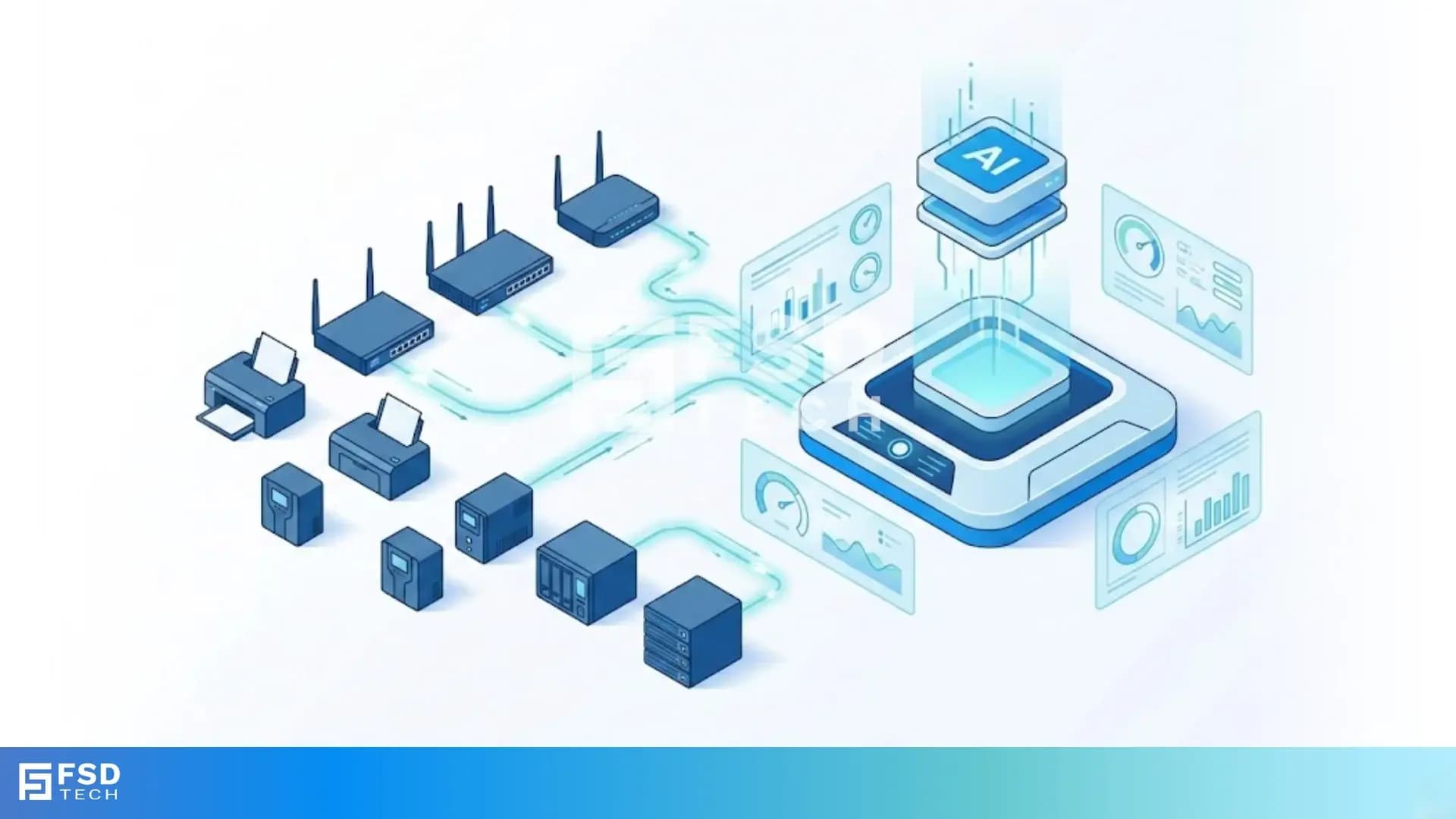
    Isometric illustration showing network infrastructure devices like routers, switches, printers, and servers connected to an AI-powered monitoring platform, representing SNMP-based infrastructure visibility and data analysis.

    Most Remote Monitoring and Management platforms begin with endpoint visibility.

    Servers.
    Workstations.
    Installed software.
    Patch status.


    But infrastructure environments rarely stop at endpoints.

    Modern IT environments also include devices such as:

    • network switches
    • routers
    • firewalls
    • printers
    • UPS systems
    • storage appliances

    These devices do not run traditional RMM agents. Yet they remain critical to operational stability.
     

    Atera addresses this visibility gap through SNMP monitoring, allowing technicians to track infrastructure health across devices that cannot run the Atera agent.


    Why SNMP Monitoring Remains Important

    SNMP (Simple Network Management Protocol) has existed for decades. Despite its age, it remains one of the most widely supported monitoring mechanisms for network infrastructure.

    Many hardware devices expose operational data through SNMP.

    This data can include:

    • device uptime
    • network interface statistics
    • hardware temperatures
    • memory usage
    • power supply health
    • storage utilization

    Without SNMP monitoring, these systems become operational blind spots.

    Atera enables IT teams to bring these devices into their monitoring environment.


    How SNMP Monitoring Works in Atera

    Atera allows administrators to configure SNMP monitoring for supported network devices.

    Instead of installing an agent, the platform communicates with the device using SNMP queries.

    The device responds with operational values stored in Management Information Bases (MIBs).

    Each measurable parameter is represented by an OID (Object Identifier).

    Examples of monitored values may include:

    • CPU utilization on a network switch
    • temperature readings on a UPS system
    • interface traffic on a router
    • disk usage on storage appliances

    Technicians can create monitoring checks based on these OIDs.


    Understanding OIDs in Network Monitoring

    OID stands for Object Identifier.

    It is essentially a unique reference that points to a specific measurable value inside a device’s MIB database.

    For example:

    • one OID may represent device uptime
    • another may represent memory usage
    • another may represent a fan status indicator

    When Atera queries the device using that OID, the device returns the current value.

    Monitoring rules can then evaluate that value and trigger alerts if thresholds are exceeded.


    The Challenge of Working with OIDs

    While SNMP monitoring is powerful, configuring it manually can be difficult.

    Technicians must often:

    • locate the correct MIB documentation
    • identify the correct OID
    • understand what the returned value represents
    • determine how the value should be interpreted

    This process can be time-consuming, particularly when dealing with unfamiliar hardware vendors.


    How Atera AI Copilot Assists with OID Generation

    Atera AI Copilot can assist technicians when working with SNMP monitoring and OID configuration.

    Technicians can use Copilot to:

    • help interpret MIB documentation
    • identify potential OIDs related to specific monitoring needs
    • explain what a given OID represents
    • assist in constructing SNMP queries

    Copilot does not automatically configure monitoring rules.
     It assists technicians in understanding and generating the correct identifiers.

    This reduces the learning curve when dealing with complex network devices.


    Practical Example: 
    Monitoring Switch Interface Utilization

    Consider a network switch experiencing intermittent congestion.

    A technician may want to monitor interface traffic utilization.

    Using SNMP monitoring, they would:

    1. Identify the OID representing interface throughput.
    2. Configure a monitoring check in Atera.
    3. Define a threshold for acceptable utilization levels.

    If the interface exceeds the threshold, Atera can generate alerts.

    AI Copilot can assist by helping the technician identify the relevant OID and interpret its meaning.


    Monitoring Hardware Health with SNMP

    Many infrastructure devices expose hardware health indicators via SNMP.

    Examples include:

    • fan failures
    • temperature thresholds
    • power supply status
    • hardware sensor alerts

    Monitoring these parameters allows technicians to detect hardware degradation before it results in outages.

    This proactive monitoring is especially valuable in distributed environments managed by MSPs.


    SNMP Monitoring in MSP Environments

    Managed Service Providers often support diverse infrastructure environments.

    Different clients may use different vendors for:

    • networking equipment
    • storage systems
    • power infrastructure

    SNMP monitoring allows MSPs to bring these heterogeneous devices into a single monitoring framework.

    Instead of managing separate monitoring tools for network infrastructure, technicians can consolidate visibility inside Atera.


    SNMP Monitoring for Internal IT Teams

    Internal IT teams use SNMP monitoring to track infrastructure health within corporate networks.

    Common monitoring scenarios include:

    • switch uptime monitoring
    • router traffic utilization
    • printer error alerts
    • UPS battery status

    These signals provide early warning indicators that allow teams to intervene before users experience disruption.


    Integrating Infrastructure Monitoring with Endpoint Visibility

    The real advantage of SNMP monitoring in Atera appears when infrastructure and endpoint monitoring operate together.

    Technicians can observe:

    • endpoint performance issues
    • network device utilization
    • infrastructure health signals

    in the same operational environment.

    This integrated visibility improves troubleshooting accuracy.

    Instead of investigating endpoints in isolation, technicians can identify whether issues originate from network infrastructure.


    AI Assistance Without Replacing Network Expertise

    AI Copilot does not replace network engineering expertise.

    SNMP monitoring still requires:

    • understanding device behavior
    • interpreting network performance metrics
    • defining meaningful thresholds

    What Copilot provides is assistance in interpreting technical documentation and generating monitoring queries.

    The technician remains responsible for configuration and operational decisions.


    Infrastructure Visibility Without Agent Installation

    Not every device can run an RMM agent.

    Network infrastructure, embedded systems, and specialized appliances require alternative monitoring methods.

    Atera’s SNMP monitoring ensures these devices remain visible within the operational environment.

    Combined with AI Copilot assistance for OID interpretation, technicians can expand monitoring coverage without introducing additional complexity.


    Want to extend your monitoring beyond endpoints with Atera SNMP? → Book a 30-minute Atera infrastructure monitoring consultation with our experts.


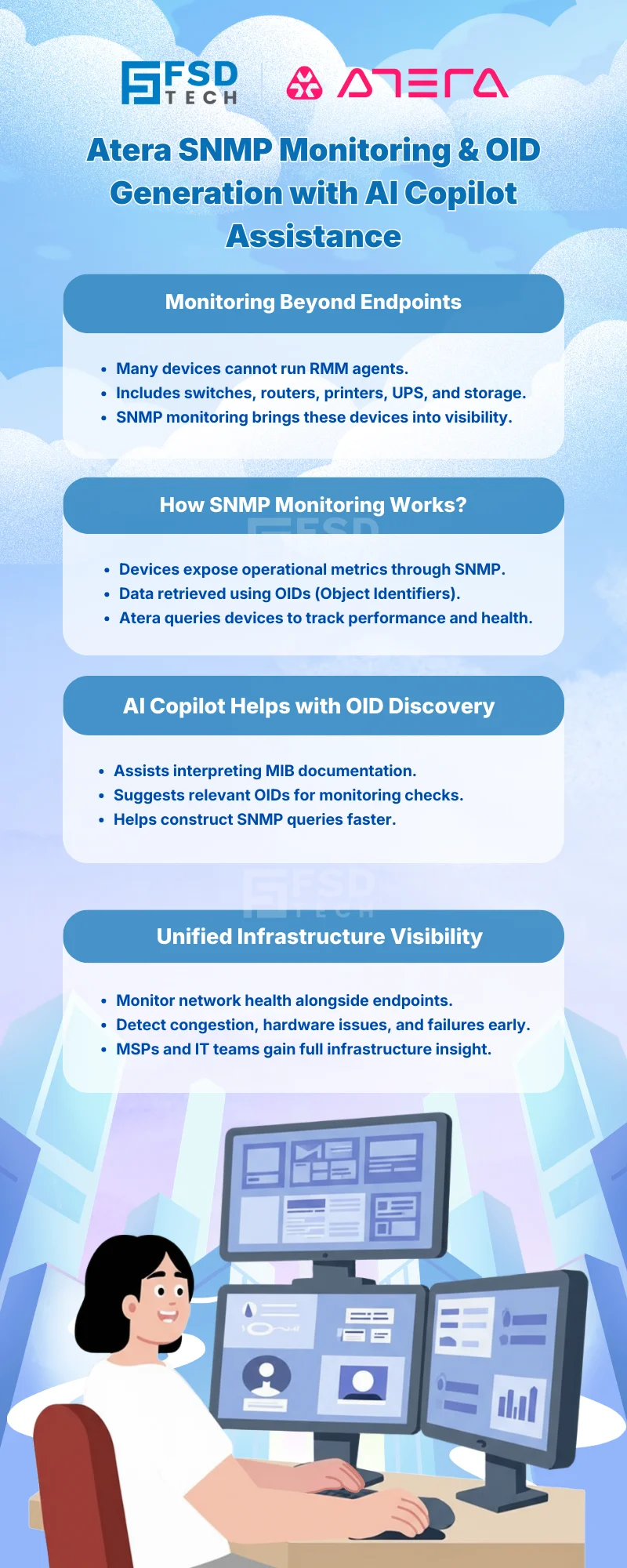
    Infographic explaining Atera SNMP monitoring and OID generation with AI Copilot, highlighting agentless monitoring, OID-based data retrieval, AI-assisted OID discovery, and unified visibility across network infrastructure and endpoints


    Frequently Asked Questions

    What is SNMP monitoring in Atera RMM?

    SNMP monitoring in Atera allows technicians to monitor network infrastructure devices such as routers, switches, printers, and UPS systems using the Simple Network Management Protocol instead of installing an agent.


    What are OIDs in Atera SNMP monitoring?

    OIDs (Object Identifiers) represent measurable parameters within a device’s Management Information Base (MIB). Atera uses these identifiers to query devices and retrieve operational values such as CPU usage, temperature, or network throughput.


    How does Atera AI Copilot assist with SNMP monitoring?

    Atera AI Copilot assists technicians by helping interpret MIB documentation, identify relevant OIDs, explain monitoring parameters, and assist with constructing SNMP queries.


    Can Atera monitor network switches and routers using SNMP?

    Yes. Atera SNMP monitoring allows technicians to monitor network switches, routers, printers, UPS systems, and other infrastructure devices that expose operational metrics through SNMP.


    Does Atera AI Copilot automatically configure SNMP monitoring?

    No. Atera AI Copilot provides assistance in identifying and interpreting OIDs but does not automatically configure monitoring rules or modify network devices.


    Why do MSPs use SNMP monitoring in Atera?

    MSPs use SNMP monitoring to track infrastructure health across diverse client environments where network devices cannot run the Atera agent.


    What types of infrastructure devices can be monitored using Atera SNMP?

    Common SNMP-monitored devices include network switches, routers, storage appliances, UPS systems, printers, and other hardware devices that expose operational data through SNMP.


    How does SNMP monitoring improve troubleshooting workflows?

    SNMP monitoring allows technicians to detect infrastructure issues such as network congestion, hardware failures, or temperature problems before they impact endpoint performance.

    Seeing Beyond Endpoints: How Atera SNMP Monitoring Extends Visibility Across Network Infrastructure

    About The Author

    Anas Abdu Rauf

    Anas is an Expert in Network and Security Infrastructure, With over seven years of industry experience, holding certifications Including CCIE- Enterprise, PCNSE, Cato SASE Expert, and Atera Certified Master. Anas provides his valuable insights and expertise to readers.

    TRY OUR PRODUCTS

    Like This Story?

    Share it with friends!

    Subscribe to our newsletter!

    FishOSCato SASEVembuXcitiumZeta HRMSAtera
    Isometric illustration of a centralized performance platform connected to analytics dashboards and team members, representing goal alignment, measurable outcomes, risk visibility, and strategic project tracking within ClickUp.

    How ClickUp Enables Outcome-Based Project Management (Not Just Task Tracking)

    🕓 February 15, 2026

    Isometric illustration of a centralized executive dashboard platform connected to analytics panels, performance charts, security indicators, and strategic milestones, representing real-time business visibility and decision control within ClickUp.

    Executive Visibility in ClickUp – How CXOs Gain Real-Time Control Without Micromanaging

    🕓 February 13, 2026

    Cato SASE Architecture

    Inside Cato’s SASE Architecture: A Blueprint for Modern Security

    🕓 January 26, 2025

    Workflow Automation(8)

    Workforce Automation(1)

    AI Project Management(1)

    HR Data Automation(1)

    RMM(2)

    IT Workflow Automation(1)

    GCC compliance(4)

    IT security(2)

    Payroll Integration(2)

    IT support automation(3)

    procurement automation(1)

    lost device management(1)

    IT Management(5)

    IoT Security(3)

    Cato XOps(1)

    IT compliance(5)

    Task Automation(1)

    Workflow Management(1)

    AI-powered cloud ops(1)

    Kubernetes lifecycle management(2)

    OpenStack automation(1)

    SMB Security(8)

    Data Security(1)

    MDR (Managed Detection & Response)(3)

    MSP Automation(3)

    Atera Integrations(2)

    XDR Security(2)

    Threat Detection & Response(1)

    Ransomware Defense(3)

    SMB Cyber Protection(1)

    HR Tech Solutions(1)

    Zero Trust Network Access(3)

    Post-Quantum Cryptography(1)

    Quantum Threat UAE & GCC(1)

    Quantum Security(1)

    Zero Trust Security(2)

    Cloud IDE Security(1)

    Endpoint Management(1)

    SaaS Security(2)

    Payroll Automation(5)

    IT Monitoring(2)

    Xcitium EDR SOC(15)

    Ransomware Protection GCC(1)

    Network Consolidation UAE(1)

    M&A IT Integration(1)

    MSSP for SMBs(1)

    Managed EDR FSD-Tech(1)

    FSD-Tech MSSP(25)

    Ransomware Protection(3)

    Antivirus vs EDR(1)

    SMB Cybersecurity GCC(1)

    Endpoint Security(1)

    Cybersecurity GCC(15)

    Data Breach Costs(1)

    Endpoint Protection(1)

    SMB Cybersecurity(8)

    Managed Security Services(2)

    Xcitium EDR(30)

    Zero Dwell Containment(31)

    Hybrid Backup(1)

    Cloud Backup(1)

    Backup & Recovery(1)

    pointguard ai(4)

    vembu(9)

    SMB data protection(9)

    disaster recovery myths(1)

    backup myths(1)

    Disaster Recovery(4)

    Vembu BDR Suite(19)

    DataProtection(1)

    GCCBusiness(1)

    Secure Access Service Edge(4)

    Unified Network Management(1)

    GCC IT Solutions(1)

    GCC HR software(20)

    open banking(1)

    financial cybersecurity(2)

    CC compliance(1)

    Miradore EMM(15)

    Cato SASE(9)

    Government Security(1)

    GCC Education(1)

    Hybrid Learning(1)

    Cloud Security(9)

    Talent Development(1)

    AI Governance(4)

    AI Compliance(2)

    AI Security(2)

    AI Cybersecurity(13)

    AI Risk Management(1)

    Secure Remote Access(1)

    GCC business security(1)

    GCC network integration(1)

    compliance automation(5)

    education security(1)

    GCC cybersecurity(3)

    BYOD security Dubai(8)

    App management UAE(1)

    Miradore EMM Premium+(5)

    MiddleEast(1)

    share your thoughts

    Isometric illustration showing network infrastructure devices like routers, switches, printers, and servers connected to an AI-powered monitoring platform, representing SNMP-based infrastructure visibility and data analysis.

    Seeing Beyond Endpoints: How Atera SNMP Monitoring Extends Visibility Across Network Infrastructure

    🕓 March 25, 2026

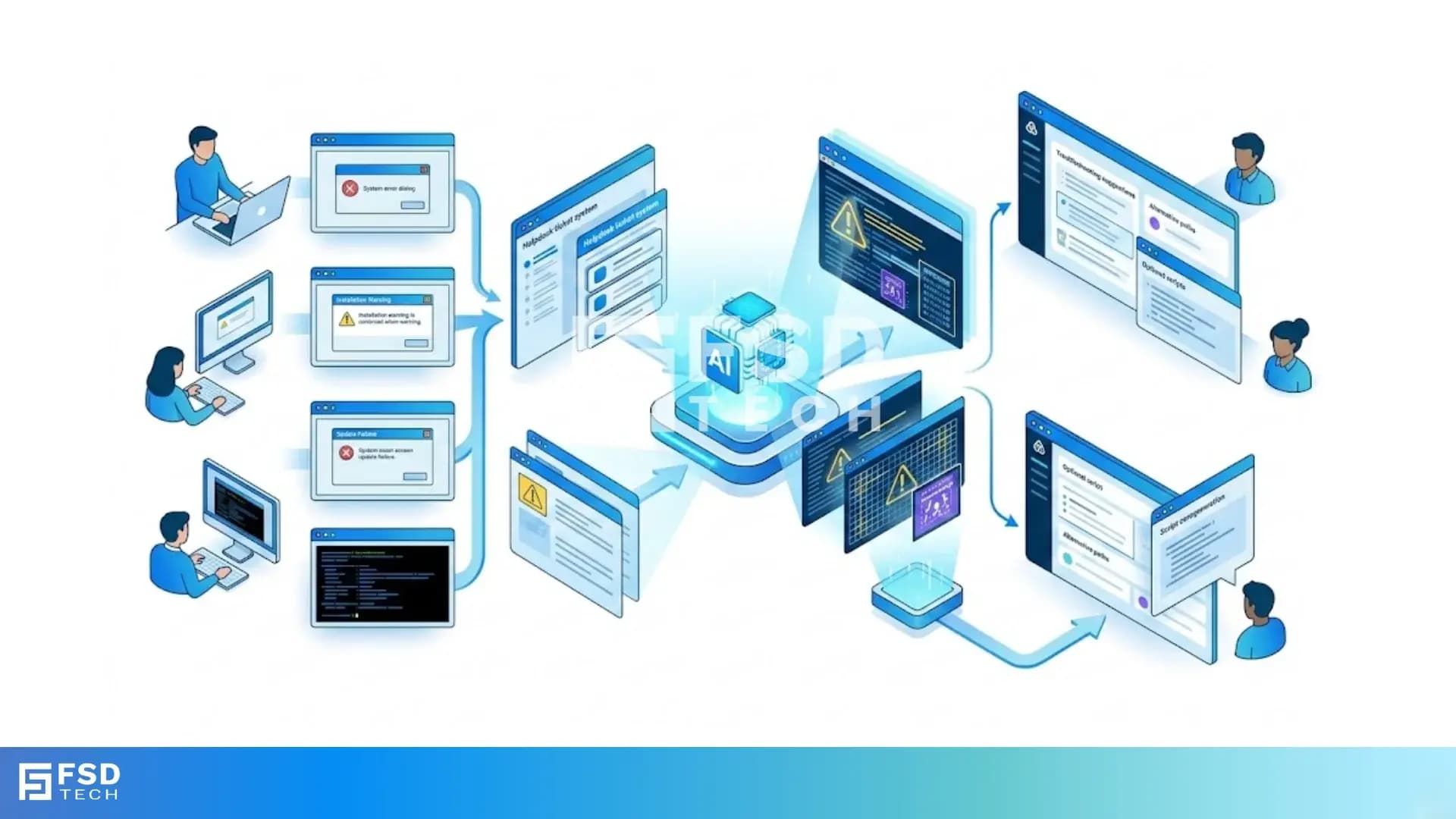
    Isometric diagram illustrating Atera AI Copilot analyzing screenshots, system errors, and warning messages to assist IT teams with faster troubleshooting, root cause analysis, and remediation guidance.

    When a Screenshot Explains More Than a Ticket: How Atera AI Copilot Image Analysis Supports Faster Troubleshooting

    🕓 March 22, 2026

    hIsometric diagram illustrating Atera AI Copilot supporting persistent AI conversations and multi-chat workflows, helping IT teams analyze infrastructure data, maintain troubleshooting context, and manage multiple technical investigations simultaneously.

    Conversations That Continue: How Atera AI Copilot Multi-Chat Improves IT Troubleshooting Context

    🕓 March 20, 2026

    Decoded(172)

    Cyber Security(128)

    BCP / DR(22)

    Zeta HRMS(78)

    SASE(21)

    Automation(78)

    Next Gen IT-Infra(128)

    Monitoring & Management(80)

    ITSM(22)

    HRMS(21)

    Automation(24)