.webp&w=3840&q=75)
How ClickUp Enables Outcome-Based Project Management (Not Just Task Tracking)
🕓 February 15, 2026
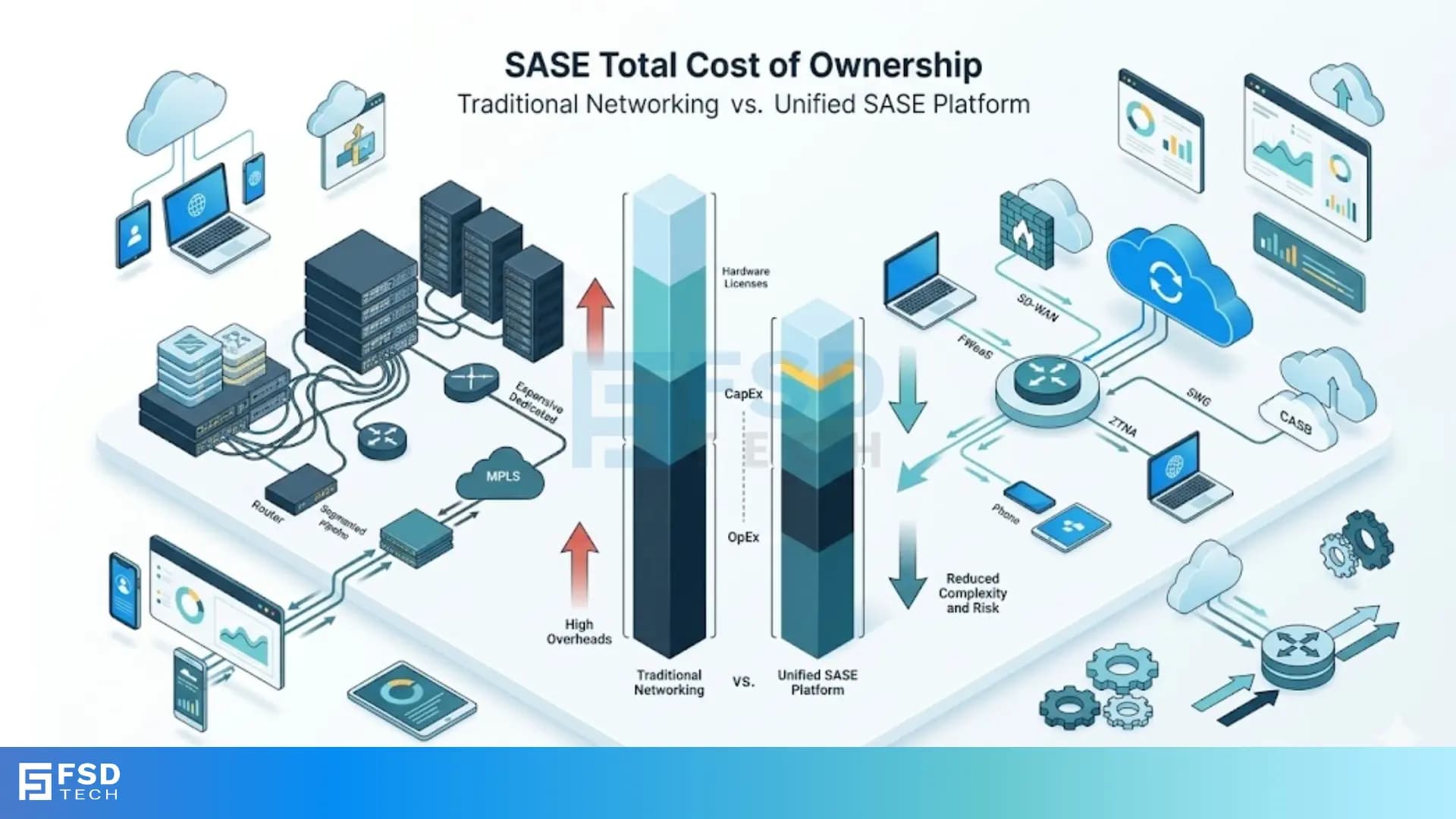
Have you ever looked at your IT budget and felt like you were paying for a digital junkyard? You keep buying "best-of-breed" tools to fix new problems, but your costs just keep climbing. It's the classic "point solution" trap. We’ve all been there—juggling different vendors, complex integrations, and a mountain of maintenance tasks that eat up your team’s time.
But what if you could trade that pile of hardware for a single, streamlined service? That is the promise of SASE Total Cost of Ownership. By converging networking and security into a unified cloud platform, Secure Access Service Edge (SASE) doesn't just change how you work—it changes how much you spend.
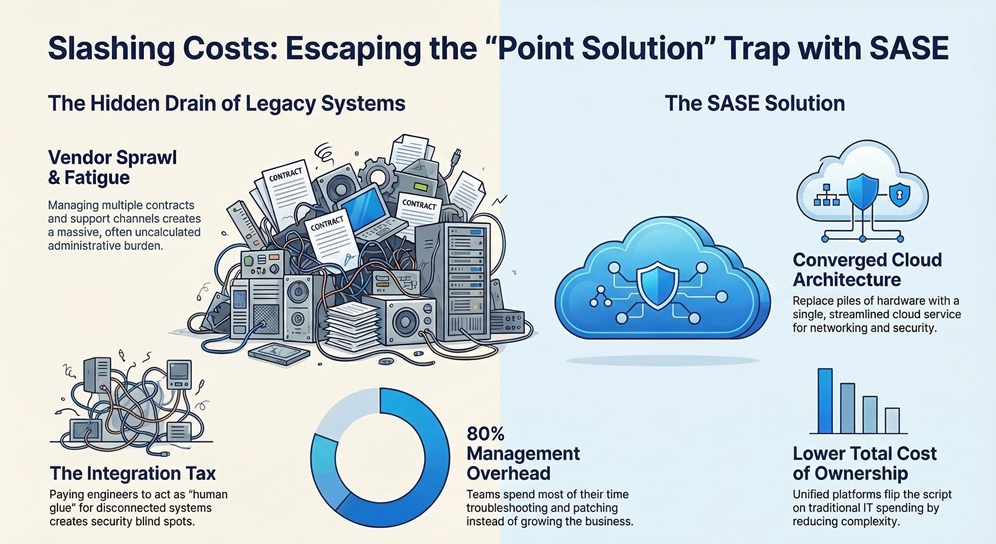
Is SASE actually cheaper than your current setup? Let's break down the hidden drains on your budget and see how a converged architecture flips the script on traditional IT spending.
To understand the Total Cost of Ownership (TCO) of SASE, we first have to look at the "sweat and tears" of the old way. Historically, IT teams added a new product for every new problem—a firewall here, a VPN there, and maybe an SD-WAN appliance for the branch offices.
Here’s the thing: the price tag on the box is only the tip of the iceberg.
1. Procurement and Vendor Fatigue
Think about the time you spend evaluating five different vendors, negotiating five contracts, and managing five different support channels. This "vendor sprawl" creates a massive administrative burden that most companies forget to calculate in their TCO.
2. The Integration Tax
Point products weren't born to talk to each other. You end up paying your smartest engineers to act as "human glue," trying to get disparate systems to share data. This complexity leads to "integration debt" and, eventually, security blind spots.
3. Management Overhead
In my experience, the biggest cost isn't the hardware—it's the people. When your team spends 80% of their day just keeping the lights on (patching, updating, and troubleshooting), they can't focus on the projects that actually grow your business.
Also Read: Cloud On-Ramp and Cloud Connect: For Better Networking
When you move to a SASE model, you aren't just moving your firewalls to the cloud. You are moving to an OpEx-based subscription model that eliminates many of these hidden costs.
Cutting the Cord on MPLS
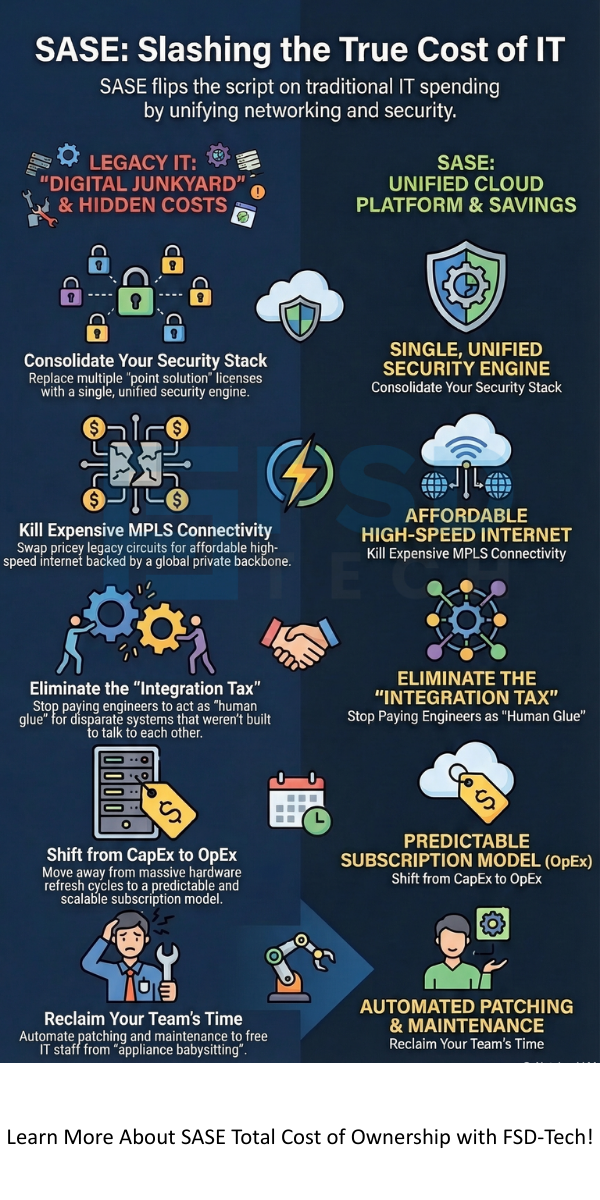
Traditional networks often rely on expensive MPLS links to stay secure. By using a SASE cloud with a global private backbone, you can replace those pricey circuits with affordable high-speed internet. This alone often pays for the migration.
Radical Consolidation
Why pay for five different security licenses when one platform can do it all? SASE converges FWaaS, SWG, CASB, and ZTNA into one engine. This means one contract, one management console, and one set of policies to maintain.
Operational Efficiency
Because SASE is cloud-native, the provider handles the heavy lifting—scaling, patching, and hardware refreshes. This frees your IT staff from "appliance babysitting". We're talking about a shift from manual labor to automated policy management.
Let's look at a realistic example. Imagine a global manufacturer with factories in three countries. They used to have a stack of firewalls and routers at every site. Every time they opened a new plant, it took months to order hardware and get a team on-site for setup.
By switching to SASE, they deployed simple "sockets" that connected instantly to the cloud. They slashed their hardware costs, eliminated MPLS fees, and reduced their deployment time from months to days. In my view, the "agility" factor is just as valuable as the direct savings.
Also Read: SASE Point of Presence (PoP): The Heart of Cloud-Native Networking
Ask yourself these three questions:
If the answers make you cringe, you're likely paying a high price for a fragmented system.
Transitioning to SASE isn't just about buying a new tool; it's about adopting a smarter way to run your business. We believe in building networks that work for you, not the other way around. At Cato, we're focused on helping you reclaim your budget and your time so you can focus on what you do best.
Ready to stop agonizing over point solutions? Let’s talk about how we can simplify your world.
Get Your Free TCO Assessment Today
Not necessarily. Many companies start with one "entry point," like replacing a legacy VPN with ZTNA or migrating an aging branch firewall to the cloud. You can phase it in as your current hardware reaches the end of its life.
To be honest, while global firms see huge savings on international links, even mid-sized companies benefit from the reduced complexity. If you have more than two or three locations and remote users, the TCO shift is usually worth it.
While I'm not an insurance agent, better visibility and a stronger security posture (like Zero Trust) often make you a "lower risk" in the eyes of insurers. Unified logging also makes audits much easier.

Surbhi Suhane is an experienced digital marketing and content specialist with deep expertise in Getting Things Done (GTD) methodology and process automation. Adept at optimizing workflows and leveraging automation tools to enhance productivity and deliver impactful results in content creation and SEO optimization.
Share it with friends!

.webp&w=3840&q=75)
share your thoughts