HomeManaged ServicesNext Gen IT-InfraMonitoring & ManagementCyber SecurityBCP / DRAutomation
Managed Services
msp-dubai-accounting-firms-managed-it

Why accounting firms in Dubai need an MSP before they think they do?

🕓 April 24, 2026

How FSD-Tech Deploys Xcitium Managed Security in the GCC

How FSD-Tech Deploys Xcitium Managed Security in the GCC

🕓 May 11, 2026

Next Gen IT-Infra
Cato’s SASE Supports Cybersecurity Skills Development

How Cato’s SASE Supports Cybersecurity Skills Development

🕓 April 8, 2025

How SASE Supports the Security Needs of SMBs

How SASE Supports the Security Needs of SMBs

🕓 February 9, 2025

Attack Surface Reduction with Cato’s SASE

Attack Surface Reduction with Cato’s SASE

🕓 February 10, 2025

SASE for Digital Transformation in UAE

SASE for Digital Transformation in UAE

🕓 February 8, 2025

Monitoring & Management
Cost-Performance Ratio: Finding the Right Balance in IT Management Networks

Cost-Performance Ratio: Finding the Right Balance in IT Management Networks

🕓 June 16, 2025

Atera’s Communication Tools

Atera’s Communication Tools: Boosting IT Team Productivity in the UAE

🕓 February 8, 2025

Emerging Trends in IT Management

Emerging Trends in IT Management

🕓 February 10, 2025

Atera Disaster Recovery

Atera Disaster Recovery: Top Strategies for UAE IT Teams

🕓 February 9, 2025

Cyber Security
Illustration of the Cato Cloud architecture showing its role in delivering SASE for secure, optimized global connectivity.

Understanding the Cato Cloud and Its Role in SASE

🕓 January 29, 2025

Isometric illustration of professionals managing network performance, bandwidth analytics, and cloud-based optimization around the Cato Networks platform, symbolizing bandwidth control and QoS visibility.

Mastering Bandwidth Control and QoS in Cato Networks

🕓 July 26, 2025

Global network backbone powering Cato SASE solution for secure, high-performance connectivity across regions.

Global Backbone: The Engine Powering Cato’s SASE Solution

🕓 January 30, 2025

Illustration of team analyzing application traffic and usage insights on a large laptop screen using Cato’s dashboard, surrounded by network and cloud icons.

Cato Networks Application Visibility | Monitoring & Control

🕓 July 27, 2025

BCP / DR
Illustration showing diverse business and IT professionals collaborating with cloud, backup, and security icons, representing Vembu use cases for SMBs, MSPs, and IT teams.

Who Uses Vembu? Real-World Use Cases for SMBs, MSPs & IT Teams

🕓 July 12, 2025

Graphic showcasing Vembu’s all-in-one backup and disaster recovery platform with icons for cloud, data protection, and business continuity for IT teams and SMBs.

What Is Vembu? A Deep Dive Into the All in One Backup & Disaster Recovery Platform

🕓 July 6, 2025

Illustration showing Vembu backup and disaster recovery system with cloud storage, server racks, analytics dashboard, and IT professionals managing data.

The Rising Cost of Data Loss: Why Backup Is No Longer Optional?

🕓 August 14, 2025

3D isometric illustration of cloud backup and data recovery infrastructure with laptop, data center stack, and digital business icons — FSD Tech

RPO & RTO: The Heart of Business Continuity

🕓 August 15, 2025

Automation
Cross-Functional Collaboration with ClickUp

Fostering Cross-Functional Collaboration with ClickUp for Multi-Departmental Projects

🕓 February 11, 2025

ClickUp Project Reporting

Revolutionizing Enterprise Reporting with ClickUp’s Advanced Analytics and Dashboards

🕓 June 16, 2025

ClickUp’s Design Collaboration and Asset Management Tools

Empowering Creative Teams with ClickUp’s Design Collaboration and Asset Management Tools

🕓 February 26, 2025

ClickUp Communication and Collaboration Tools

ClickUp Communication and Collaboration Tools: Empowering Remote Teams

🕓 March 12, 2025

    Subscribe to our newsletter!

    About Us

    Follow Us

    Copyright © 2024 | Powered by 

    Atera

    (60)

    Cato Networks

    (131)

    ClickUp

    (78)

    FishOS

    (7)

    Miradore

    (21)

    PointGuard AI

    (9)

    Vembu

    (26)

    Xcitium

    (35)

    ZETA HRMS

    (79)

    Table of Contents

    What is Token Ring Topology? How it Works?

    Surbhi Suhane
    April 17, 2026
    Comments
    Token Ring Topology

    What is Token Ring Topology? How it Works

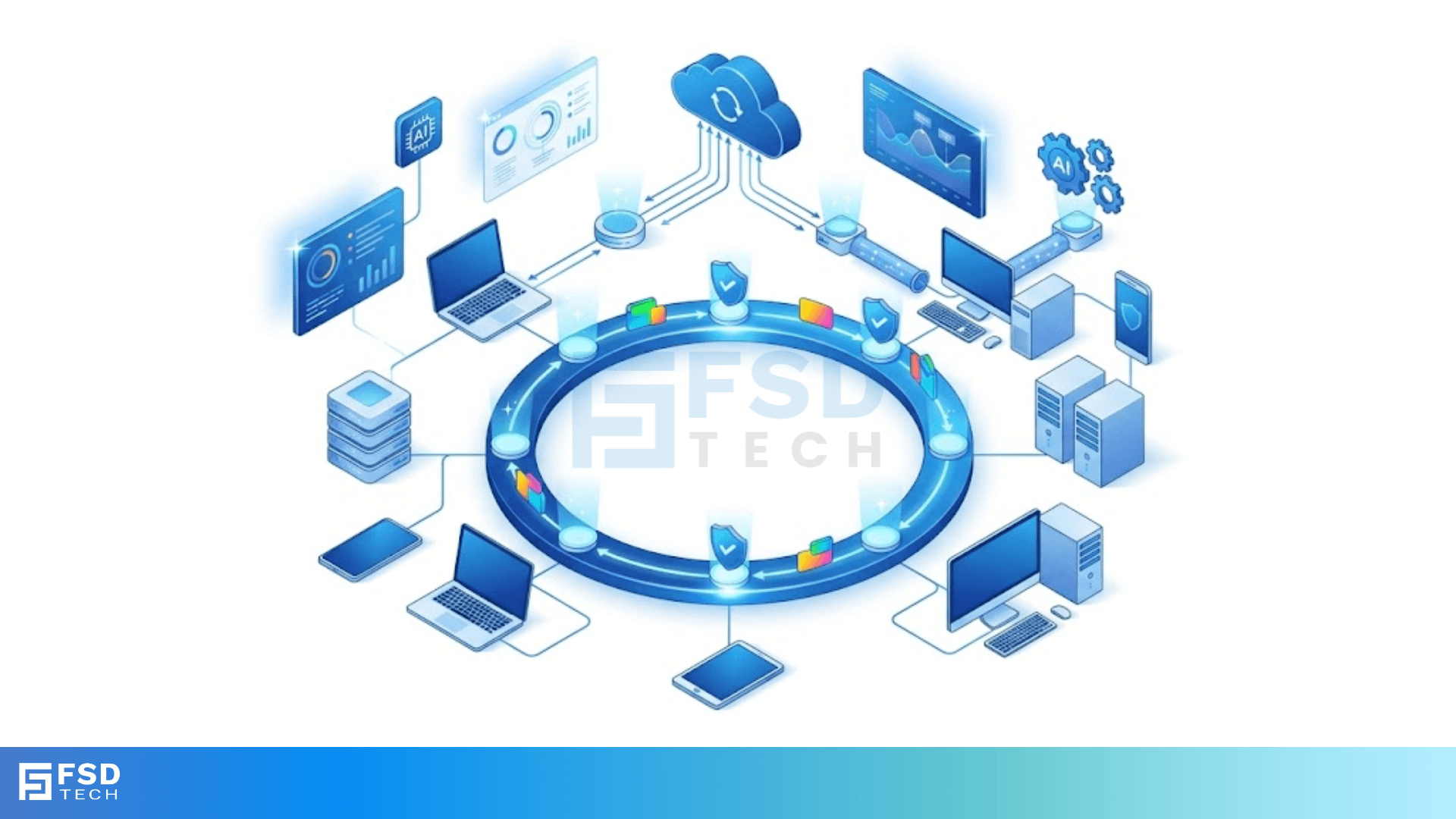
    Token Ring topology is a classic way to connect computers in a local area network where every device sits in a circular data path. Think of it like a group of people sitting at a round table passing a single talking stick. If you have the stick, you can speak. If you don't, you listen. This simple rule makes the network very orderly.


    Have you ever wondered how old-school networks handled heavy traffic without crashing? Unlike modern Wi-Fi or Ethernet, which can sometimes get "noisy," this system is all about waiting your turn. To be honest, we've all been in meetings where everyone talks at once and nothing gets done. In my view, networking engineers solved that problem decades ago with the "token" concept.


    How Does Token Ring Topology Move Your Data?

    In a Token Ring topology setup, data travels in one direction. It moves from one computer to the next until it reaches its goal. But how does a computer know when to start sending? It waits for a special 3-byte frame called a "token."


    Here is the thing: the token is always moving around the circle. When a computer wants to send a file, it "grabs" the empty token. It then changes a bit in the frame to say, "I'm busy!" Now, it attaches the data and the address of the person who should receive it.


    Get Expert Tech Support


    The Life of a Data Frame

    1. Waiting: Your computer watches the ring for an idle token.
    2. Capturing: Once the token arrives, your PC grabs it and adds your data.
    3. Traveling: The frame moves around the ring. Every PC looks at the address. If it's not for them, they just pass it on.
    4. Receiving: The target computer copies the data. It then sends the frame back to the sender to say "Got it!"
    5. Releasing: The sender sees the "received" flag, removes the data, and puts the empty token back on the ring.


    Is it a bit slower than modern fiber? Maybe. But it's very reliable. You won't see "data collisions" here because only one person holds the token at a time.


    The Role of the IEEE 802.5 Standard

    When we talk about this tech, we must mention IEEE 802.5. This is the official "rulebook" for how these networks play together. IBM actually started this trend in the 1980s, and it became a hit for big businesses.

    IBM created the Token Ring topology to handle high-pressure environments. While early Ethernet was like a chaotic race, 802.5 was a planned parade. It uses "deterministic" access. This means you can actually calculate exactly how long it will take for a piece of data to move. In a factory or a bank, that kind of timing is worth its weight in gold.


    Why We Use a Multistation Access Unit (MAU)

    Wait, if the network is a ring, what happens if one computer breaks? Wouldn't the whole circle snap? To be honest, that was a big worry early on. That is why we use a Multistation Access Unit, or MAU.


    The MAU acts like a hub. Even though the logic is a circle, the physical wires look like a star. If your laptop dies, the MAU just bypasses your port. The "ring" stays closed inside the box. This clever trick means one broken wire won't take down the whole office.


    Also Read: Gain Real-Time Endpoint Intelligence with the Cato Device Dashboard


    Essential Features of Token Ring Topology

    What makes Token Ring topology stand out from the crowd? It isn't just the shape. It’s the way the system thinks.


    • No Collisions: Since you need the token to talk, two computers never whisper at the same time.
    • Priority Systems: You can actually tell the network that some data is more important. High-priority traffic can "reserve" the next token.
    • Equal Access: Every device gets a fair shot at the token. No one gets left out in the cold.
    • Fault Detection: The network has a "monitor" station. If the token gets lost (yes, it happens!), the monitor creates a new one.


    To be honest, we've all felt the frustration of a slow, jammed-up Wi-Fi. In contrast, this ring setup stays steady even when things get busy. It doesn't get faster, but it doesn't get slower either.


    Token Ring vs. Ethernet: Which is Better?

    Now, let's discuss the elephant in the room. Why do most of us use Ethernet today instead of Token Ring topology?


    FeatureToken Ring (IEEE 802.5)Ethernet (IEEE 802.3)
    Data AccessDeterministic (Token)Probabilistic (CSMA/CD)
    CollisionsNoneCommon (on older hubs)
    CostExpensive hardwareCheap and easy
    Speed4 Mbps to 16 Mbps100 Mbps to 10 Gbps+


    Ethernet won the war because it was cheaper and easier to scale. However, for a long time, Token Ring was the "professional" choice. It felt more stable for banks and hospitals where data loss wasn't an option.


    Understanding the "Monitor" Station

    In every Token Ring topology, one computer is elected as the "Active Monitor." Think of it as the network's referee. What does it actually do?


    If a computer crashes while holding the token, the token vanishes. The monitor notices the silence. It then "cleans" the ring and prints a fresh token. It also makes sure the "clock" stays in sync. Without a monitor, the ring would eventually stall. It's roughly the most important job in the system, even if you never see it happening.


    Physical vs. Logical Layout

    One common mistake is thinking the wires must be in a literal circle around the room. In reality, Token Ring topology usually looks like a star. We call this a "logical ring" but a "physical star."


    The cables all run back to that MAU we talked about. This makes it easy to add new people to the network. You just plug a new cable into the hub. Behind the scenes, the electrical signal still does a full lap through every device. It's a bit like a subway line that goes in a loop—even if the tracks look messy on a map, the train always follows the same round path.


    Also Read: Cato SASE and DNS Security: Preventing and Mitigating DNS-Based Attacks


    Advantages of Using a Ring Setup

    Why did engineers fall in love with Token Ring topology in the first place? It comes down to control.


    1. Stability under load: When traffic gets heavy, Ethernet can buckle. This ring keeps moving at the same pace.
    2. Troubleshooting: It is very easy to find a break. The MAU can tell you exactly which port stopped responding.
    3. Distance: Because each computer regenerates the signal before passing it on, these networks can cover decent distances without the signal getting weak.


    Disadvantages to Consider

    Nothing is perfect. That said, there are reasons we don't see this tech in every home today.


    • High Cost: The cards and hubs cost way more than Ethernet.
    • Complexity: Setting up the priority bits and monitor stations takes more brainpower.
    • Bottleneck: If you have 50 computers, the token has to pass through 49 others before it gets back to you. This "latency" can be annoying.


    Conclusion

    Understanding Token Ring topology gives you a deep look into how we solved the problem of "too many voices" in a network. It's a brilliant piece of engineering that prioritized order over raw speed. In my experience, learning the roots of tech makes us better at handling the modern stuff.


    At FSD-Tech, we value the same reliability that the Token Ring provided to the world. We believe that your data should always have a clear, safe path to its destination. Whether you are building a new system or fixing an old one, we are here to ensure your connections never break..


    Click here for a free consultation


    Key Takeaways for Token Ring Topology

    • Token Ring topology uses a 3-byte token to manage data flow and prevent crashes.
    • It follows the IEEE 802.5 standard, which ensures high reliability.
    • The MAU is the heart of the system, keeping the ring alive even if a PC fails.
    • It is "deterministic," meaning every device gets a guaranteed turn to speak.
    • While it’s rare today, its logic lives on in modern high-speed "Fiber Distributed Data Interface" (FDDI) systems.


    Frequently Asked Questions on Token Ring Topology

    Is Token Ring the same as a Star Topology?

    Not exactly. It often looks like a star because of the central hub (MAU), but the data moves in a circle. We call this a "Physical Star, Logical Ring."


    What happens if the token is lost?

    The Active Monitor station detects the silence. It then resets the ring and generates a new token to get things moving again.


    Can I use Token Ring for my home internet?

    Technically, no. Modern routers and devices use Ethernet and Wi-Fi. Token Ring hardware is mostly found in legacy industrial or banking systems now.

    What is Token Ring Topology? How it Works?

    About The Author

    Surbhi Suhane

    Surbhi Suhane is an experienced digital marketing and content specialist with deep expertise in Getting Things Done (GTD) methodology and process automation. Adept at optimizing workflows and leveraging automation tools to enhance productivity and deliver impactful results in content creation and SEO optimization.

    TRY OUR PRODUCTS

    Like This Story?

    Share it with friends!

    Subscribe to our newsletter!

    FishOSCato SASEVembuXcitiumZeta HRMSAtera
    Isometric illustration of a centralized performance platform connected to analytics dashboards and team members, representing goal alignment, measurable outcomes, risk visibility, and strategic project tracking within ClickUp.

    How ClickUp Enables Outcome-Based Project Management (Not Just Task Tracking)

    🕓 February 15, 2026
    Isometric illustration of a centralized executive dashboard platform connected to analytics panels, performance charts, security indicators, and strategic milestones, representing real-time business visibility and decision control within ClickUp.

    Executive Visibility in ClickUp – How CXOs Gain Real-Time Control Without Micromanaging

    🕓 February 13, 2026

    Cato SASE Architecture

    Inside Cato’s SASE Architecture: A Blueprint for Modern Security

    🕓 January 26, 2025

    Workflow Automation(8)

    Workforce Automation(1)

    AI Project Management(1)

    HR Data Automation(1)

    RMM(2)

    Firewall Security(1)

    IT Workflow Automation(1)

    GCC compliance(4)

    IT security(2)

    Payroll Integration(2)

    IT support automation(3)

    procurement automation(1)

    lost device management(1)

    IT Management(5)

    IoT Security(3)

    Cato XOps(1)

    IT compliance(5)

    Workflow Management(1)

    Task Automation(1)

    AI-powered cloud ops(1)

    OpenStack automation(1)

    Kubernetes lifecycle management(2)

    SMB Security(8)

    Data Security(1)

    MDR (Managed Detection & Response)(3)

    Atera Integrations(2)

    MSP Automation(3)

    Threat Detection & Response(1)

    XDR Security(2)

    SMB Cyber Protection(1)

    Ransomware Defense(3)

    HR Tech Solutions(1)

    Zero Trust Network Access(3)

    Quantum Security(1)

    Quantum Threat UAE & GCC(1)

    Post-Quantum Cryptography(1)

    Cloud IDE Security(1)

    Zero Trust Security(2)

    Endpoint Management(1)

    SaaS Security(2)

    Payroll Automation(5)

    IT Monitoring(2)

    Xcitium EDR SOC(15)

    Ransomware Protection GCC(1)

    M&A IT Integration(1)

    Network Consolidation UAE(1)

    MSSP for SMBs(1)

    Managed EDR FSD-Tech(1)

    SMB Cybersecurity GCC(1)

    Antivirus vs EDR(1)

    FSD-Tech MSSP(25)

    Ransomware Protection(3)

    Endpoint Security(1)

    Cybersecurity GCC(15)

    Data Breach Costs(1)

    Endpoint Protection(1)

    Managed Security Services(2)

    SMB Cybersecurity(8)

    Zero Dwell Containment(31)

    Xcitium EDR(30)

    Cloud Backup(1)

    Hybrid Backup(1)

    Backup & Recovery(1)

    pointguard ai(4)

    vembu(9)

    backup myths(1)

    disaster recovery myths(1)

    SMB data protection(9)

    Disaster Recovery(4)

    Vembu BDR Suite(19)

    DataProtection(1)

    GCCBusiness(1)

    Unified Network Management(1)

    GCC IT Solutions(1)

    Secure Access Service Edge(4)

    GCC HR software(20)

    open banking(1)

    financial cybersecurity(2)

    CC compliance(1)

    Miradore EMM(15)

    Cato SASE(9)

    Government Security(1)

    Cloud Security(9)

    Hybrid Learning(1)

    GCC Education(1)

    Talent Development(1)

    AI Compliance(2)

    AI Risk Management(1)

    AI Governance(4)

    AI Security(2)

    AI Cybersecurity(13)

    Secure Remote Access(1)

    GCC business security(1)

    GCC network integration(1)

    compliance automation(5)

    education security(1)

    GCC cybersecurity(3)

    Miradore EMM Premium+(5)

    App management UAE(1)

    BYOD security Dubai(8)

    share your thoughts

    SLIP Serial Encapsulation

    What is SLIP Serial Encapsulation? How it works?

    🕓 May 9, 2026

    PPP Authentication CHAP

    What is PPP Authentication CHAP? Dive into Secure Networking

    🕓 May 9, 2026

    HDLC Bit-Oriented Framing

    HDLC Bit-Oriented Framing: Guide to Data Link Control

    🕓 May 8, 2026