HomeNext Gen IT-InfraMonitoring & ManagementCyber SecurityBCP / DRAutomationDecoded
Next Gen IT-Infra
Cato’s SASE Supports Cybersecurity Skills Development

How Cato’s SASE Supports Cybersecurity Skills Development

🕓 April 8, 2025

How SASE Supports the Security Needs of SMBs

How SASE Supports the Security Needs of SMBs

🕓 February 9, 2025

Attack Surface Reduction with Cato’s SASE

Attack Surface Reduction with Cato’s SASE

🕓 February 10, 2025

SASE for Digital Transformation in UAE

SASE for Digital Transformation in UAE

🕓 February 8, 2025

Monitoring & Management
Understanding Atera’s SLA Management

Understanding Atera’s SLA Management

🕓 February 7, 2025

Cost-Performance Ratio: Finding the Right Balance in IT Management Networks

Cost-Performance Ratio: Finding the Right Balance in IT Management Networks

🕓 June 16, 2025

Customizing Atera with APIs

Customizing Atera with APIs

🕓 March 3, 2025

Power Up Your IT Team’s Strategy with Atera’s Communication Tools

Power Up Your IT Team’s Strategy with Atera’s Communication Tools

🕓 February 8, 2025

Cyber Security
Illustration of the Cato Cloud architecture showing its role in delivering SASE for secure, optimized global connectivity.

Understanding the Cato Cloud and Its Role in SASE

🕓 January 29, 2025

Isometric illustration of professionals managing network performance, bandwidth analytics, and cloud-based optimization around the Cato Networks platform, symbolizing bandwidth control and QoS visibility.

Mastering Bandwidth Control and QoS in Cato Networks

🕓 July 26, 2025

Global network backbone powering Cato SASE solution for secure, high-performance connectivity across regions.

Global Backbone: The Engine Powering Cato’s SASE Solution

🕓 January 30, 2025

Illustration of team analyzing application traffic and usage insights on a large laptop screen using Cato’s dashboard, surrounded by network and cloud icons.

Cato Networks Application Visibility | Monitoring & Control

🕓 July 27, 2025

BCP / DR
Illustration showing diverse business and IT professionals collaborating with cloud, backup, and security icons, representing Vembu use cases for SMBs, MSPs, and IT teams.

Who Uses Vembu? Real-World Use Cases for SMBs, MSPs & IT Teams

🕓 July 12, 2025

Graphic showcasing Vembu’s all-in-one backup and disaster recovery platform with icons for cloud, data protection, and business continuity for IT teams and SMBs.

What Is Vembu? A Deep Dive Into the All in One Backup & Disaster Recovery Platform

🕓 July 6, 2025

Illustration showing Vembu backup and disaster recovery system with cloud storage, server racks, analytics dashboard, and IT professionals managing data.

The Rising Cost of Data Loss: Why Backup Is No Longer Optional?

🕓 August 14, 2025

3D isometric illustration of cloud backup and data recovery infrastructure with laptop, data center stack, and digital business icons — FSD Tech

RPO & RTO: The Heart of Business Continuity

🕓 August 15, 2025

Automation
Cross-Functional Collaboration with ClickUp

Fostering Cross-Functional Collaboration with ClickUp for Multi-Departmental Projects

🕓 February 11, 2025

ClickUp Project Reporting

Revolutionizing Enterprise Reporting with ClickUp’s Advanced Analytics and Dashboards

🕓 June 16, 2025

ClickUp’s Design Collaboration and Asset Management Tools

Empowering Creative Teams with ClickUp’s Design Collaboration and Asset Management Tools

🕓 February 26, 2025

ClickUp Communication and Collaboration Tools

ClickUp Communication and Collaboration Tools: Empowering Remote Teams

🕓 March 12, 2025

Decoded
Multi-Factor Authentication (MFA)

Multi-Factor Authentication (MFA): All You Need to Know

🕓 December 7, 2025

L3 Switch

What Is an L3 Switch? L2 vs L3 & Why You Need Layer 3?

🕓 December 8, 2025

IPSec

IPSec Explained: Protocols, Modes, IKE & VPN Security

🕓 December 3, 2025

 Datagram Transport Layer Security (DTLS)

What is Datagram Transport Layer Security (DTLS)? How it works?

🕓 December 4, 2025

    Subscribe to our newsletter!

    About Us

    Follow Us

    Copyright © 2024 | Powered by 

    Atera

    (56)

    Cato Networks

    (130)

    ClickUp

    (78)

    FishOS

    (7)

    Miradore

    (21)

    PointGuard AI

    (9)

    Vembu

    (22)

    Xcitium

    (33)

    ZETA HRMS

    (79)

    Table of Contents

    Scaling Service Mesh: How to Grow Your Network Without the Headaches

    Surbhi Suhane
    March 17, 2026
    Comments
    scaling service mesh

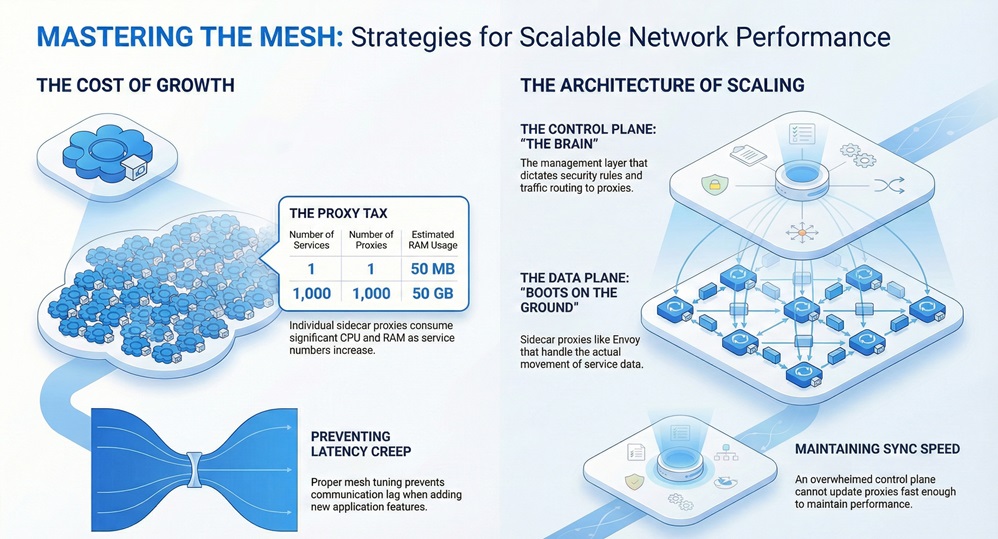
    Scaling service mesh is the secret to keeping your microservices fast and reliable as your traffic hits new peaks. We've all been there: your app is growing, you add more services, and suddenly, things feel a bit laggy. You might wonder, "Is the network holding us back?" It’s a common hurdle, but once you get the hang of how the data plane and control plane interact, you’ll see the path forward.


    What is the Goal of Scaling Service Mesh?

    When we talk about a service mesh (SM), we're looking at a dedicated layer that handles how your services talk to each other. It takes the heavy lifting of security, traffic, and "observability" off your developers' plates. But as you add hundreds of proxies, the mesh itself needs to grow.


    Scaling Service Mesh


    Have you ever noticed your latency creeping up as you add more features? 


    That’s often because the mesh needs a bit of tuning. Scaling service mesh isn't just about adding more power; it’s about making the system smarter.


    Why Scaling Service Mesh Matters for Your Business

    In my experience, many teams treat the mesh like a "set it and forget it" tool. That’s a mistake. A service mesh uses a "sidecar" pattern where a small proxy (like Envoy) sits next to every service.

    As you scale, these sidecars consume CPU and memory. If you have 1,000 services, you have 1,000 proxies. If each one uses 50MB of RAM, you’re looking at 50GB just for the network layer! That’s why we need to focus on efficiency.


    Get Your Free Mesh Audit

    The Two Sides of the Scaling Coin

    To scale properly, we have to look at two main parts:


    1. The Data Plane: This is the "boots on the ground." These are the proxies that actually move the data.
    2. The Control Plane: This is the "brain." It tells the proxies where to send traffic and what security rules to follow.


    If the brain (control plane) gets overwhelmed, it can't update the proxies fast enough. If the proxies (data plane) are too heavy, they slow down your app.


    Strategic Steps for Scaling Service Mesh

    How do we actually make this work in the real world? It comes down to a few key moves.


    1. Optimize the Sidecar Configuration

    By default, many SM tools send the entire cluster's map to every single proxy. Does a "Payment Service" really need to know about the "Image Resize Service"? Probably not.

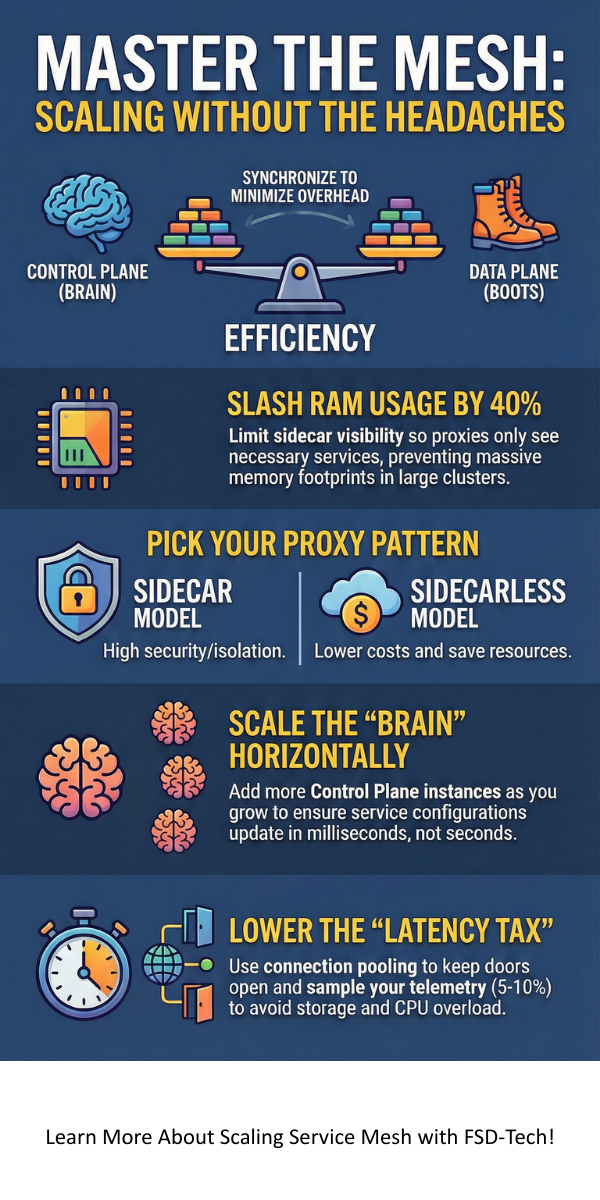
    To keep things light, you should use "Sidecar Resources" to limit what each proxy sees. This reduces the memory footprint significantly. In fact, we've seen cases where this simple change cut memory usage by 40%.


    2. Choose the Right Architecture: Sidecars vs. Sidecarless

    There is a big debate right now about "sidecarless" mesh (like Istio’s Ambient Mesh). Instead of putting a proxy in every pod, you use a shared proxy for the whole node.


    • Sidecar Model: Great for high security and isolation.
    • Sidecarless Model: Better for saving resources and lowering costs.


    Which one fits your needs? If you're running on a tight budget, the sidecarless approach might be your best friend.


    3. Manage the Control Plane Load

    As your cluster grows, the control plane has to work harder to push updates. You can scale the control plane horizontally. This means adding more "brains" to handle the load. This ensures that when a new service starts, it gets its configuration in milliseconds, not seconds.


    Also Read: Autonomous Mesh Networking: For Smart Connectivity


    Best Practices for Scaling Service Mesh

    Here’s the thing: scaling isn’t just a technical task; it’s a strategy. We’ve all seen clusters crash because a single update flooded the network. Here is how we avoid that.


    Use Namespace Isolation

    Don't let every service talk to every other service. Use namespaces to group related tasks. This creates smaller "islands" within your mesh, making it much easier to manage and scale.


    Implement Connection Pooling

    Opening and closing connections is expensive for a CPU. By using connection pooling, the mesh keeps connections open and reuses them. It's like keeping a door open for a crowd instead of locking and unlocking it for every person.


    Monitor Your Overhead

    You can't fix what you don't measure. Use tools like Prometheus to track how much CPU your proxies use. If you see a spike, it’s time to check your "load balancing" settings.


    Pro Tip: Always look at the "99th percentile" latency. It tells you the worst-case scenario for your users, which is usually where the scaling issues hide.


    Also Read: Mesh Architecture: How to Decentralize Your Data


    Common Challenges in Scaling Service Mesh

    Scaling isn't always smooth sailing. You will likely hit a few bumps.


    Latency "Tax"

    Every time data passes through a proxy, it adds a tiny bit of time. While 1ms sounds small, it adds up if your request passes through five different services.


    Configuration Complexity

    The more you scale, the more YAML files you have to manage. This is where "GitOps" comes in handy. It helps you automate the changes so you don't make a manual typo that brings down the site.


    Telemetry Overload

    A service mesh generates a lot of data. Logs, traces, and metrics can quickly fill up your storage. We recommend "sampling" your traces. You don't need to record 100% of every click; 5% or 10% is usually enough to see the big picture.


    Conclusion

    Scaling service mesh is a journey, not a destination. As your business grows, your network needs to be flexible enough to grow with it. By focusing on smart configurations, choosing the right proxy model, and keeping a close eye on your metrics, you can build a system that is both powerful and efficient.


    At our core, we believe in building tech that empowers people. We’re here to help you navigate these complex waters so you can focus on what really matters: delivering value to your customers. We've helped dozens of clients turn their messy networks into sleek, high-performing machines, and we're ready to do the same for you.


    Scaling Service Mesh infographic


    Ready to streamline your network? Let’s talk about how we can optimize your infrastructure today.


    Optimize My Mesh Now


    Key Takeaways for Scaling Service Mesh

    • Limit Visibility: Only give proxies the info they need to reduce RAM usage.
    • Scale Horizontally: Add more control plane instances as your service count grows.
    • Watch the Tax: Keep an eye on the CPU and latency overhead of your sidecars.
    • Automate Everything: Use code to manage your mesh configurations to avoid human error.
    • Pick Your Pattern: Choose between sidecars or shared node proxies based on your cost goals.


    Frequently Asked Questions

    Does a service mesh always slow down my app?

    It adds a very small amount of latency. However, the benefits of security and better traffic control usually outweigh that tiny delay. Proper scaling and tuning can keep this "tax" very low.


    When should I start scaling my mesh?

    You should look at scaling once you hit about 50 to 100 microservices. Before that, the standard settings usually work fine. Once you go bigger, you'll notice the resource usage start to climb.


    Is Istio the only option for scaling?

    No, there are many options like Linkerd, Consul, and Kuma. Linkerd is known for being very light and fast, which makes it a great choice if you are worried about the “latency tax.”

    Scaling Service Mesh: How to Grow Your Network Without the Headaches

    About The Author

    Surbhi Suhane

    Surbhi Suhane is an experienced digital marketing and content specialist with deep expertise in Getting Things Done (GTD) methodology and process automation. Adept at optimizing workflows and leveraging automation tools to enhance productivity and deliver impactful results in content creation and SEO optimization.

    TRY OUR PRODUCTS

    Like This Story?

    Share it with friends!

    Subscribe to our newsletter!

    FishOSCato SASEVembuXcitiumZeta HRMSAtera
    Isometric illustration of a centralized performance platform connected to analytics dashboards and team members, representing goal alignment, measurable outcomes, risk visibility, and strategic project tracking within ClickUp.

    How ClickUp Enables Outcome-Based Project Management (Not Just Task Tracking)

    🕓 February 15, 2026
    Isometric illustration of a centralized executive dashboard platform connected to analytics panels, performance charts, security indicators, and strategic milestones, representing real-time business visibility and decision control within ClickUp.

    Executive Visibility in ClickUp – How CXOs Gain Real-Time Control Without Micromanaging

    🕓 February 13, 2026

    Cato SASE Architecture

    Inside Cato’s SASE Architecture: A Blueprint for Modern Security

    🕓 January 26, 2025

    Workflow Automation(8)

    Workforce Automation(1)

    AI Project Management(1)

    HR Data Automation(1)

    RMM(2)

    IT Workflow Automation(1)

    GCC compliance(4)

    IT security(2)

    Payroll Integration(2)

    IT support automation(3)

    procurement automation(1)

    lost device management(1)

    IT Management(5)

    IoT Security(2)

    Cato XOps(1)

    IT compliance(4)

    Task Automation(1)

    Workflow Management(1)

    Kubernetes lifecycle management(2)

    OpenStack automation(1)

    AI-powered cloud ops(1)

    SMB Security(8)

    Data Security(1)

    MDR (Managed Detection & Response)(3)

    Atera Integrations(2)

    MSP Automation(3)

    XDR Security(2)

    Threat Detection & Response(1)

    SMB Cyber Protection(1)

    Ransomware Defense(3)

    HR Tech Solutions(1)

    Zero Trust Network Access(3)

    Quantum Threat UAE & GCC(1)

    Post-Quantum Cryptography(1)

    Quantum Security(1)

    Cloud IDE Security(1)

    Zero Trust Security(2)

    Endpoint Management(1)

    SaaS Security(2)

    Payroll Automation(5)

    IT Monitoring(2)

    Xcitium EDR SOC(15)

    Ransomware Protection GCC(1)

    Network Consolidation UAE(1)

    M&A IT Integration(1)

    MSSP for SMBs(1)

    Managed EDR FSD-Tech(1)

    SMB Cybersecurity GCC(1)

    FSD-Tech MSSP(25)

    Ransomware Protection(3)

    Antivirus vs EDR(1)

    Endpoint Security(1)

    Cybersecurity GCC(14)

    Data Breach Costs(1)

    Endpoint Protection(1)

    SMB Cybersecurity(8)

    Xcitium EDR(30)

    Zero Dwell Containment(31)

    Managed Security Services(2)

    Cloud Backup(1)

    Hybrid Backup(1)

    Backup & Recovery(1)

    pointguard ai(4)

    vembu(9)

    backup myths(1)

    disaster recovery myths(1)

    SMB data protection(9)

    Disaster Recovery(4)

    Vembu BDR Suite(19)

    DataProtection(1)

    GCCBusiness(1)

    Secure Access Service Edge(4)

    GCC IT Solutions(1)

    Unified Network Management(1)

    GCC HR software(20)

    open banking(1)

    financial cybersecurity(2)

    CC compliance(1)

    Miradore EMM(15)

    Government Security(1)

    Cato SASE(9)

    GCC Education(1)

    Hybrid Learning(1)

    Cloud Security(9)

    Talent Development(1)

    AI Governance(4)

    AI Compliance(2)

    AI Cybersecurity(13)

    AI Security(2)

    AI Risk Management(1)

    Secure Remote Access(1)

    GCC business security(1)

    GCC network integration(1)

    compliance automation(5)

    GCC cybersecurity(3)

    education security(1)

    App management UAE(1)

    BYOD security Dubai(8)

    Miradore EMM Premium+(5)

    MiddleEast(1)

    share your thoughts

    Anycast

    Anycast: How It Powers Global Content Delivery

    🕓 March 17, 2026

    scaling service mesh

    Scaling Service Mesh: How to Grow Your Network Without the Headaches

    🕓 March 17, 2026

    Identity-First Security

    Identity-First Security: Why Your Identity is the New Network Perimeter

    🕓 March 16, 2026

    Decoded(160)

    Cyber Security(127)

    BCP / DR(22)

    Zeta HRMS(78)

    SASE(21)

    Automation(78)

    Next Gen IT-Infra(127)

    Monitoring & Management(77)

    ITSM(22)

    HRMS(21)

    Automation(24)