HomeManaged ServicesNext Gen IT-InfraMonitoring & ManagementCyber SecurityBCP / DRAutomation
Managed Services
msp-dubai-accounting-firms-managed-it

Why accounting firms in Dubai need an MSP before they think they do?

🕓 April 24, 2026

Next Gen IT-Infra
Cato’s SASE Supports Cybersecurity Skills Development

How Cato’s SASE Supports Cybersecurity Skills Development

🕓 April 8, 2025

How SASE Supports the Security Needs of SMBs

How SASE Supports the Security Needs of SMBs

🕓 February 9, 2025

Attack Surface Reduction with Cato’s SASE

Attack Surface Reduction with Cato’s SASE

🕓 February 10, 2025

SASE for Digital Transformation in UAE

SASE for Digital Transformation in UAE

🕓 February 8, 2025

Monitoring & Management
Cost-Performance Ratio: Finding the Right Balance in IT Management Networks

Cost-Performance Ratio: Finding the Right Balance in IT Management Networks

🕓 June 16, 2025

Atera’s Communication Tools

Atera’s Communication Tools: Boosting IT Team Productivity in the UAE

🕓 February 8, 2025

Emerging Trends in IT Management

Emerging Trends in IT Management

🕓 February 10, 2025

Atera Disaster Recovery

Atera Disaster Recovery: Top Strategies for UAE IT Teams

🕓 February 9, 2025

Cyber Security
Illustration of the Cato Cloud architecture showing its role in delivering SASE for secure, optimized global connectivity.

Understanding the Cato Cloud and Its Role in SASE

🕓 January 29, 2025

Isometric illustration of professionals managing network performance, bandwidth analytics, and cloud-based optimization around the Cato Networks platform, symbolizing bandwidth control and QoS visibility.

Mastering Bandwidth Control and QoS in Cato Networks

🕓 July 26, 2025

Global network backbone powering Cato SASE solution for secure, high-performance connectivity across regions.

Global Backbone: The Engine Powering Cato’s SASE Solution

🕓 January 30, 2025

Illustration of team analyzing application traffic and usage insights on a large laptop screen using Cato’s dashboard, surrounded by network and cloud icons.

Cato Networks Application Visibility | Monitoring & Control

🕓 July 27, 2025

BCP / DR
Illustration showing diverse business and IT professionals collaborating with cloud, backup, and security icons, representing Vembu use cases for SMBs, MSPs, and IT teams.

Who Uses Vembu? Real-World Use Cases for SMBs, MSPs & IT Teams

🕓 July 12, 2025

Graphic showcasing Vembu’s all-in-one backup and disaster recovery platform with icons for cloud, data protection, and business continuity for IT teams and SMBs.

What Is Vembu? A Deep Dive Into the All in One Backup & Disaster Recovery Platform

🕓 July 6, 2025

Illustration showing Vembu backup and disaster recovery system with cloud storage, server racks, analytics dashboard, and IT professionals managing data.

The Rising Cost of Data Loss: Why Backup Is No Longer Optional?

🕓 August 14, 2025

3D isometric illustration of cloud backup and data recovery infrastructure with laptop, data center stack, and digital business icons — FSD Tech

RPO & RTO: The Heart of Business Continuity

🕓 August 15, 2025

Automation
Cross-Functional Collaboration with ClickUp

Fostering Cross-Functional Collaboration with ClickUp for Multi-Departmental Projects

🕓 February 11, 2025

ClickUp Project Reporting

Revolutionizing Enterprise Reporting with ClickUp’s Advanced Analytics and Dashboards

🕓 June 16, 2025

ClickUp’s Design Collaboration and Asset Management Tools

Empowering Creative Teams with ClickUp’s Design Collaboration and Asset Management Tools

🕓 February 26, 2025

ClickUp Communication and Collaboration Tools

ClickUp Communication and Collaboration Tools: Empowering Remote Teams

🕓 March 12, 2025

    Subscribe to our newsletter!

    About Us

    Follow Us

    Copyright © 2024 | Powered by 

    Atera

    (60)

    Cato Networks

    (131)

    ClickUp

    (78)

    FishOS

    (7)

    Miradore

    (21)

    PointGuard AI

    (9)

    Vembu

    (22)

    Xcitium

    (33)

    ZETA HRMS

    (79)

    Table of Contents

    RIP Hop Count Metric in Modern Networking

    Surbhi Suhane
    April 28, 2026
    Comments
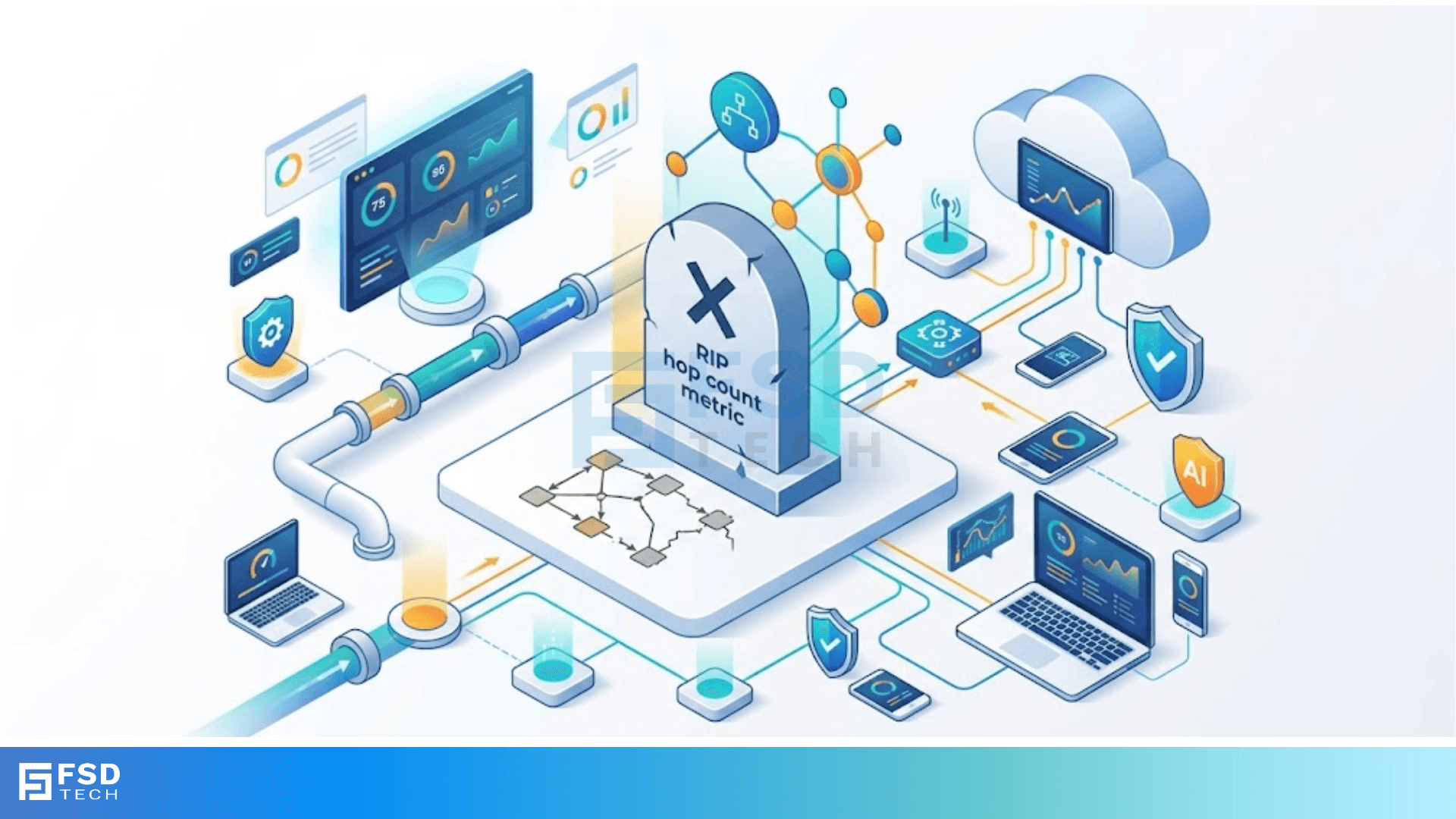
    RIP Hop Count Metric

    The RIP hop count metric serves as the primary measurement for determining the best path across a network. If you've ever wondered how a router decides which way to send your data, you're looking at the heart of the Routing Information Protocol. It's one of the oldest methods in the book, but it's still a cornerstone for anyone learning how data travels from point A to point B.


    Imagine you're trying to find the quickest way to a friend's house. Do you take the road with fewer intersections or the one with less traffic? For this protocol, it always picks the path with the fewest "stops." In the networking world, we call these stops "hops."


    To be honest, we've all been there—stuck trying to figure out why a network isn't scaling. Often, the answer lies in these simple rules. In this guide, we'll break down how this system works, why it has a "speed limit," and how it keeps your data moving without getting lost in circles.


    What is the RIP Hop Count Metric?

    At its core, the RIP hop count metric is a value that represents the distance between a source and a destination. Every time a data packet passes through a router, that counts as one hop. Think of it like a tally mark on a traveler's map.


    Optimize Your Routing Now


    How Routers Calculate Distance?

    When a router learns about a new network from a neighbor, it doesn't just take the neighbor's word for it. It takes the neighbor’s distance and adds one. This simple addition is how the Routing Information Protocol (RIP) builds its view of the world.


    Here is the basic logic:


    • Directly Connected: If a network is plugged right into the router, the distance is 0.
    • One Step Away: If your neighbor says they are 0 hops from a network, you are now 1 hop away.
    • The Increment: Every time an update moves to the next device, the RIP hop count metric increases by one.


    The Magic Number 15

    One of the most famous parts of this protocol is its strict limit. You can only have 15 hops. If a destination requires 16 hops, the router considers it "infinite." In plain English? It’s unreachable. This limit exists to prevent data from looping forever if there's a mistake in the network map.


    Also Read: VLAN Segmentation: The Ultimate Guide to Network Security


    How Routing Updates Use the Metric

    In my experience, watching a routing table update in real-time is the best way to understand this. Routers talk to each other every 30 seconds. They share their lists of networks and how many hops it takes to get there.


    Step-by-Step Update Process

    1. The Broadcast: Router A sends out its table.
    2. The Reception: Router B receives the list.
    3. The Math: Router B looks at each entry and adds "1" to the hop count.
    4. The Decision: If Router B already knew a way to that network, it compares the new number to the old one. It only keeps the shortest path.


    "A router is like a gossiping neighbor. It only tells you what it heard from others, plus its own little twist (adding a hop)."


    Why 30 Seconds Matters?

    These periodic updates ensure that everyone stays on the same page. However, it’s a bit of a double-edged sword. If a link goes down, it can take a while for the "bad news" to travel. This is why some people call RIP a "slow" protocol.


    Solving the Count-to-Infinity Problem

    Here’s the thing: simple logic can sometimes lead to big headaches. If a network path fails, two routers might keep telling each other they have a way to reach it, slowly increasing the hop count each time. This is the "Count-to-Infinity" problem.


    To fix this, the RIP hop count metric uses a few clever tricks:


    Split Horizon

    This rule is simple: a router shouldn't advertise a route back to the neighbor it learned it from. If I learned about the "Gaming Network" from you, I won't tell you I have a path to it. That would be silly, right?


    Poison Reverse

    This is a bit more aggressive. When a route fails, the router immediately sets the metric to 16. It then tells everyone else, "Hey, this path is now infinite." It 'poisons' the route so nobody tries to use it.


    Also Read: Is MAC Address Filtering Still Relevant for Your Network Security?


    RIPv1 vs. RIPv2: Does the Metric Change?

    While the core RIP hop count metric remains the same—limited to 15—the way versions handle it differs.


    FeatureRIPv1RIPv2
    Max Hop Count1515
    Subnet SupportNo (Classful)Yes (VLSM)
    Update MethodBroadcast (255.255.255.255)Multicast (224.0.0.9)
    AuthenticationNoneMD5/Plain Text

    Fast-forward to today, and you'll mostly see RIPv2 or RIPng (for IPv6). Even though the metric hasn't changed, the efficiency of how those metrics are shared has improved vastly.


    Conclusion

    Understanding the RIP hop count metric is like learning the foundation of a building. It might not be the fanciest or newest technology, but the principles of distance-vector routing keep our basic connections solid. At our core, we believe that networking should be accessible. Whether you are managing a small branch or just starting your IT journey, we focus on providing the clarity you need to succeed.

    Ready to build a more reliable network? We're here to help you navigate the complexities of routing with ease and expert support. Let's make your infrastructure work for you.


    Get Expert Network Help


    Key Takeaways on RIP Hop Count Metric

    • Small is Best: This protocol works best in small offices or labs where the network diameter is less than 15.
    • Simple Logic: It only cares about the number of routers, not how fast the cables are.
    • Loop Prevention: The 15-hop limit and Split Horizon are your best friends for stability.
    • Slow Convergence: Be patient. It takes time for the whole network to realize a link has changed.


    Frequently Asked Questions (FAQs) on RIP Hop Count Metric

    Why is 16 considered infinity in RIP?

    The designers chose 16 to keep the protocol simple and prevent infinite loops. By capping the path at 15, they ensured that the "Count-to-Infinity" process would eventually stop at a small enough number to not crash the router.


    Can I use RIP in a large enterprise network?

    Generally, no. Because the RIP hop count metric maxes out at 15, any network larger than that will have "unreachable" segments. For bigger setups, we usually recommend OSPF or EIGRP.


    Does a lower hop count always mean a faster connection?

    Not necessarily. A path with 2 hops over slow 56k dial-up is much slower than a 5-hop path over 10Gbps fiber. Since RIP only looks at hops, it can't tell the difference in speed.

    RIP Hop Count Metric in Modern Networking

    About The Author

    Surbhi Suhane

    Surbhi Suhane is an experienced digital marketing and content specialist with deep expertise in Getting Things Done (GTD) methodology and process automation. Adept at optimizing workflows and leveraging automation tools to enhance productivity and deliver impactful results in content creation and SEO optimization.

    TRY OUR PRODUCTS

    Like This Story?

    Share it with friends!

    Subscribe to our newsletter!

    FishOSCato SASEVembuXcitiumZeta HRMSAtera
    Isometric illustration of a centralized performance platform connected to analytics dashboards and team members, representing goal alignment, measurable outcomes, risk visibility, and strategic project tracking within ClickUp.

    How ClickUp Enables Outcome-Based Project Management (Not Just Task Tracking)

    🕓 February 15, 2026
    Isometric illustration of a centralized executive dashboard platform connected to analytics panels, performance charts, security indicators, and strategic milestones, representing real-time business visibility and decision control within ClickUp.

    Executive Visibility in ClickUp – How CXOs Gain Real-Time Control Without Micromanaging

    🕓 February 13, 2026

    Cato SASE Architecture

    Inside Cato’s SASE Architecture: A Blueprint for Modern Security

    🕓 January 26, 2025

    Workflow Automation(8)

    Workforce Automation(1)

    AI Project Management(1)

    HR Data Automation(1)

    RMM(2)

    Firewall Security(1)

    IT Workflow Automation(1)

    GCC compliance(4)

    IT security(2)

    Payroll Integration(2)

    IT support automation(3)

    procurement automation(1)

    lost device management(1)

    IT Management(5)

    IoT Security(3)

    Cato XOps(1)

    IT compliance(5)

    Task Automation(1)

    Workflow Management(1)

    AI-powered cloud ops(1)

    OpenStack automation(1)

    Kubernetes lifecycle management(2)

    SMB Security(8)

    Data Security(1)

    MDR (Managed Detection & Response)(3)

    MSP Automation(3)

    Atera Integrations(2)

    Threat Detection & Response(1)

    XDR Security(2)

    SMB Cyber Protection(1)

    Ransomware Defense(3)

    HR Tech Solutions(1)

    Zero Trust Network Access(3)

    Post-Quantum Cryptography(1)

    Quantum Security(1)

    Quantum Threat UAE & GCC(1)

    Zero Trust Security(2)

    Cloud IDE Security(1)

    Endpoint Management(1)

    SaaS Security(2)

    Payroll Automation(5)

    IT Monitoring(2)

    Xcitium EDR SOC(15)

    Ransomware Protection GCC(1)

    Network Consolidation UAE(1)

    M&A IT Integration(1)

    MSSP for SMBs(1)

    SMB Cybersecurity GCC(1)

    FSD-Tech MSSP(25)

    Antivirus vs EDR(1)

    Managed EDR FSD-Tech(1)

    Ransomware Protection(3)

    Cybersecurity GCC(15)

    Endpoint Security(1)

    Data Breach Costs(1)

    Endpoint Protection(1)

    Xcitium EDR(30)

    SMB Cybersecurity(8)

    Managed Security Services(2)

    Zero Dwell Containment(31)

    Hybrid Backup(1)

    Cloud Backup(1)

    Backup & Recovery(1)

    pointguard ai(4)

    vembu(9)

    SMB data protection(9)

    disaster recovery myths(1)

    backup myths(1)

    Disaster Recovery(4)

    Vembu BDR Suite(19)

    GCCBusiness(1)

    DataProtection(1)

    Unified Network Management(1)

    Secure Access Service Edge(4)

    GCC IT Solutions(1)

    GCC HR software(20)

    financial cybersecurity(2)

    CC compliance(1)

    open banking(1)

    Miradore EMM(15)

    Government Security(1)

    Cato SASE(9)

    Cloud Security(9)

    Hybrid Learning(1)

    GCC Education(1)

    Talent Development(1)

    AI Governance(4)

    AI Risk Management(1)

    AI Compliance(2)

    AI Security(2)

    AI Cybersecurity(13)

    Secure Remote Access(1)

    GCC business security(1)

    GCC network integration(1)

    compliance automation(5)

    education security(1)

    GCC cybersecurity(3)

    BYOD security Dubai(8)

    App management UAE(1)

    Miradore EMM Premium+(5)

    share your thoughts

    RIP Hop Count Metric

    RIP Hop Count Metric in Modern Networking

    🕓 April 28, 2026

    NIC Duplex Modes

    NIC Duplex Modes: Guide to Half vs Full Duplex

    🕓 April 28, 2026

    Telnet Clear-Text Risks

    Telnet Clear-Text Risks: Why Plain Text Protocols Threaten Your Security

    🕓 April 27, 2026

    Managed Services(1)

    Decoded(227)

    Cyber Security(128)

    BCP / DR(22)

    Zeta HRMS(78)

    SASE(21)

    Automation(80)

    Next Gen IT-Infra(128)

    Monitoring & Management(81)

    ITSM(22)

    HRMS(21)

    Automation(24)