HomeNext Gen IT-InfraMonitoring & ManagementCyber SecurityBCP / DRAutomationDecoded
Next Gen IT-Infra
Cato’s SASE Supports Cybersecurity Skills Development

How Cato’s SASE Supports Cybersecurity Skills Development

🕓 April 8, 2025

How SASE Supports the Security Needs of SMBs

How SASE Supports the Security Needs of SMBs

🕓 February 9, 2025

Attack Surface Reduction with Cato’s SASE

Attack Surface Reduction with Cato’s SASE

🕓 February 10, 2025

SASE for Digital Transformation in UAE

SASE for Digital Transformation in UAE

🕓 February 8, 2025

Monitoring & Management
Understanding Atera’s SLA Management

Understanding Atera’s SLA Management

🕓 February 7, 2025

Cost-Performance Ratio: Finding the Right Balance in IT Management Networks

Cost-Performance Ratio: Finding the Right Balance in IT Management Networks

🕓 June 16, 2025

Customizing Atera with APIs

Customizing Atera with APIs

🕓 March 3, 2025

Power Up Your IT Team’s Strategy with Atera’s Communication Tools

Power Up Your IT Team’s Strategy with Atera’s Communication Tools

🕓 February 8, 2025

Cyber Security
Illustration of the Cato Cloud architecture showing its role in delivering SASE for secure, optimized global connectivity.

Understanding the Cato Cloud and Its Role in SASE

🕓 January 29, 2025

Isometric illustration of professionals managing network performance, bandwidth analytics, and cloud-based optimization around the Cato Networks platform, symbolizing bandwidth control and QoS visibility.

Mastering Bandwidth Control and QoS in Cato Networks

🕓 July 26, 2025

Global network backbone powering Cato SASE solution for secure, high-performance connectivity across regions.

Global Backbone: The Engine Powering Cato’s SASE Solution

🕓 January 30, 2025

Illustration of team analyzing application traffic and usage insights on a large laptop screen using Cato’s dashboard, surrounded by network and cloud icons.

Cato Networks Application Visibility | Monitoring & Control

🕓 July 27, 2025

BCP / DR
Illustration showing diverse business and IT professionals collaborating with cloud, backup, and security icons, representing Vembu use cases for SMBs, MSPs, and IT teams.

Who Uses Vembu? Real-World Use Cases for SMBs, MSPs & IT Teams

🕓 July 12, 2025

Graphic showcasing Vembu’s all-in-one backup and disaster recovery platform with icons for cloud, data protection, and business continuity for IT teams and SMBs.

What Is Vembu? A Deep Dive Into the All in One Backup & Disaster Recovery Platform

🕓 July 6, 2025

Illustration showing Vembu backup and disaster recovery system with cloud storage, server racks, analytics dashboard, and IT professionals managing data.

The Rising Cost of Data Loss: Why Backup Is No Longer Optional?

🕓 August 14, 2025

3D isometric illustration of cloud backup and data recovery infrastructure with laptop, data center stack, and digital business icons — FSD Tech

RPO & RTO: The Heart of Business Continuity

🕓 August 15, 2025

Automation
Cross-Functional Collaboration with ClickUp

Fostering Cross-Functional Collaboration with ClickUp for Multi-Departmental Projects

🕓 February 11, 2025

ClickUp Project Reporting

Revolutionizing Enterprise Reporting with ClickUp’s Advanced Analytics and Dashboards

🕓 June 16, 2025

ClickUp’s Design Collaboration and Asset Management Tools

Empowering Creative Teams with ClickUp’s Design Collaboration and Asset Management Tools

🕓 February 26, 2025

ClickUp Communication and Collaboration Tools

ClickUp Communication and Collaboration Tools: Empowering Remote Teams

🕓 March 12, 2025

Decoded
Multi-Factor Authentication (MFA)

Multi-Factor Authentication (MFA): All You Need to Know

🕓 December 7, 2025

L3 Switch

What Is an L3 Switch? L2 vs L3 & Why You Need Layer 3?

🕓 December 8, 2025

IPSec

IPSec Explained: Protocols, Modes, IKE & VPN Security

🕓 December 3, 2025

 Datagram Transport Layer Security (DTLS)

What is Datagram Transport Layer Security (DTLS)? How it works?

🕓 December 4, 2025

    Subscribe to our newsletter!

    About Us

    Follow Us

    Copyright © 2024 | Powered by 

    Atera

    (56)

    Cato Networks

    (128)

    ClickUp

    (78)

    FishOS

    (7)

    Miradore

    (21)

    PointGuard AI

    (9)

    Vembu

    (22)

    Xcitium

    (33)

    ZETA HRMS

    (79)

    Table of Contents

    What is a Blue Team? Defensive Cybersecurity Roles & Tools

    Surbhi Suhane
    March 2, 2026
    Comments
    Blue Team

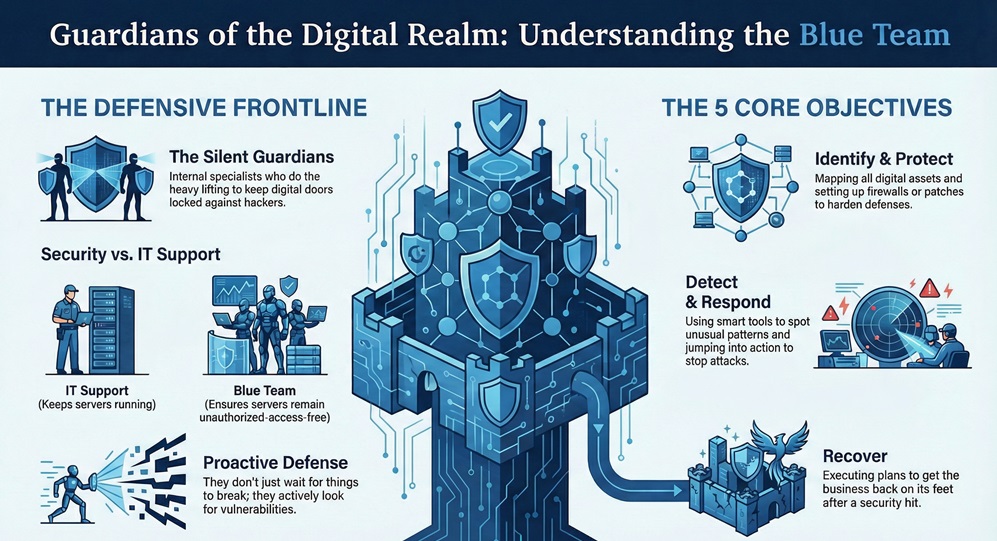
    A blue team refers to the internal security professionals who defend an organization against real-world cyber threats and simulated attacks. Think of them as the silent guardians of the digital realm. While hackers and "red teams" get the Hollywood glory for breaking into systems, the blue team does the heavy lifting to keep the doors locked.


    Are you curious about how companies actually stay safe when thousands of attacks happen every minute? To be honest, it’s not just about installing an antivirus and hoping for the best. It's a structured, constant battle.


    In this guide, we'll look at how these defensive experts operate. We’ll explore their daily tasks, the tools they use, and why they are the backbone of any modern business.


    What is a Blue Team in Cybersecurity?

    The blue team is a group of specialized individuals dedicated to protecting an organization's digital assets. Their primary job is to maintain the security posture of the network. They don’t just wait for something to break. Instead, they proactively look for holes, monitor traffic, and respond to incidents the moment they occur.


    Blue Team in Cybersecurity

    In my experience, many people confuse them with general IT support. That’s a mistake. While IT keeps the servers running, the defensive security team ensures those servers aren't being used by a stranger in another country.


    Get Proactive Defense Now


    Core Objectives of the Defensive Side

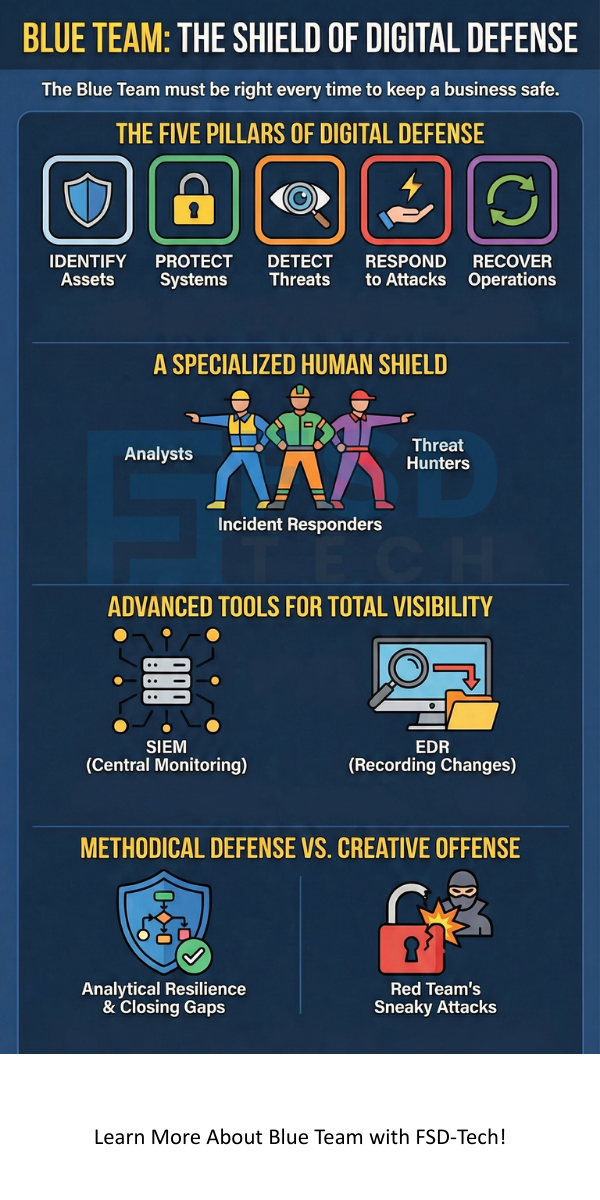
    • Identify: They map out every asset, from laptops to cloud databases.
    • Protect: They set up firewalls, patch software, and train staff.
    • Detect: They use smart tools to spot unusual patterns in data.
    • Respond: When a "red team" or a real hacker strikes, they jump into action to stop the spread.
    • Recover: They get the business back on its feet after a hit.


    Key Roles Within a Blue Team

    You might wonder, who actually sits on these teams? It isn't just one person doing everything. A mature security unit has various roles that work together like a well-oiled machine.


    1. Security Analysts

    These are the first responders. They spend their day looking at screens filled with alerts. Their goal? To decide if a "login attempt from Brazil" is a traveling employee or a thief.


    2. Incident Responders

    When a breach is confirmed, these folks take over. They follow a strict "playbook" to isolate infected computers and kick the attacker out. Have you ever seen a team move with military precision during a crisis? That's them.


    3. Threat Hunters

    This is a more advanced role. Instead of waiting for an alert, they go looking for trouble. They assume an attacker is already inside and search for tiny clues that automated tools might miss.


    4. Security Engineers

    They build the "digital citadel." These engineers configure the tools, manage the log pipelines, and ensure that the defense infrastructure is actually working.


    Also Read: Avoiding Compliance Penalties with Cato SASE: Meeting Regulatory Standards Effortlessly


    Blue Team vs. Red Team: What’s the Difference?

    We can’t talk about defense without mentioning offense. In the world of security exercises, the red team acts as the "bad guys." They are ethical hackers hired to find a way in.


    The blue team stands on the opposite side. While the red team tries to be sneaky, the defenders try to be vigilant. Roughly 70% of a company’s security maturity comes from these two teams playing against each other. We call this a "purple team" exercise when they share notes to get better.


    FeatureRed TeamBlue Team
    FocusOffense (Attacking)Defense (Protecting)
    GoalExploit vulnerabilitiesDetect and remediate
    MindsetCreative, sneaky, destructiveMethodical, analytical, resilient
    OutcomeFinds the gapsCloses the gaps


    Common Blue Team Tools and Technologies 2026

    To stay ahead of modern threats, a blue team uses a sophisticated stack of software. We've moved past simple firewalls. Today, it’s all about visibility and automation.


    SIEM (Security Information and Event Management)

    Tools like Splunk or Microsoft Sentinel act as a central brain. They collect logs from everywhere—your email, your cloud, your wifi—and look for connections. If a user logs in from New York and two minutes later from London, the SIEM screams for help.


    EDR (Endpoint Detection and Response)

    Think of EDR as a black box flight recorder for every computer in the office. It records every process and file change. If a virus starts encrypting files, the EDR can often kill the process automatically.


    Open-Source Favorites

    Many teams use powerful open-source tools to save on costs while staying sharp:


    • Wireshark: For looking at raw network traffic.
    • Suricata: A high-speed system for detecting intrusions.
    • TheHive: A platform for managing and tracking security incidents.


    Also Read: Unified Device Visibility: Enhancements to Cato’s Device Inventory


    The Daily Workflow: From Alert to Resolution

    Picture this: It’s 2:00 PM on a Tuesday. A Security Analyst gets a notification. Someone in accounting just clicked a suspicious link in an email. This is where the blue team shines.


    First, they triage the alert. Is it a false alarm? To be honest, many are. But if it’s real, they move to containment. They might disable the user’s account and disconnect their laptop from the network.


    Next comes the "eradication" phase. They find the malicious file and delete it. Finally, they perform a post-mortem. We've all been there—sitting in a meeting asking, "How did this happen?" The team uses these lessons to update their firewalls so the same trick won't work twice.


    How to Start a Career in Defensive Security

    Does this sound like something you'd enjoy? The demand for defensive pros is higher than ever. Here is a simple path to get started:


    1. Master the Basics: Learn how networks work. You can't defend what you don't understand.
    2. Get Hands-on: Use platforms like TryHackMe or Blue Team Labs Online. Practice investigating a "crime scene" in a safe environment.
    3. Certifications: Look into Blue Team Level 1 (BTL1) or the GCIH (GIAC Certified Incident Handler). These show employers you can actually do the work, not just read about it.
    4. Stay Curious: The "landscape" of threats—wait, let's say the world of threats—changes daily. You have to be a lifelong learner.


    Conclusion

    The blue team is much more than a group of IT experts; they are the strategic heart of a company's survival. By combining advanced tools with a methodical mindset, they ensure that your data stays private and your systems stay online. 


    At FSD-Tech, we believe that security is a human right for every business. We focus on building resilient defenses and empowering our clients to face the future without fear. Our values center on transparency and relentless protection, because your trust is our most valuable asset.


    Book My Free Security Audit


    blue team infographic


    Key Takeaways

    • A blue team focuses on the proactive defense and reactive response within an organization.
    • They use tools like SIEM, EDR, and traffic analyzers to maintain visibility.
    • The defensive role is more about "continuous monitoring" than one-time fixes.
    • Collaboration with red teams helps identify hidden weaknesses before real hackers find them.
    • Skills like digital forensics and log analysis are essential for anyone in this field.


    Frequently Asked Questions About Blue Team

    What is the most important skill for a blue teamer?

    In my view, it’s attention to detail. You are looking for a needle in a haystack of data. Missing one small log entry could mean missing a full-scale breach.


    Is blue teaming harder than red teaming?

    That’s a tough one! To be honest, they are just different. A red team only has to be right once to get in. A blue team has to be right every single time to stay safe.


    Do I need to know how to code?

    You don't need to be a software developer. However, knowing a bit of Python or PowerShell helps you automate boring tasks. It makes you much faster at responding to threats.


    What is a SOC?

    A SOC is a Security Operations Center. It is the physical or virtual room where the blue team works. It’s the command center for all things security.

    What is a Blue Team? Defensive Cybersecurity Roles & Tools

    About The Author

    Surbhi Suhane

    Surbhi Suhane is an experienced digital marketing and content specialist with deep expertise in Getting Things Done (GTD) methodology and process automation. Adept at optimizing workflows and leveraging automation tools to enhance productivity and deliver impactful results in content creation and SEO optimization.

    TRY OUR PRODUCTS

    Like This Story?

    Share it with friends!

    Subscribe to our newsletter!

    FishOSCato SASEVembuXcitiumZeta HRMSAtera
    Isometric illustration of a centralized performance platform connected to analytics dashboards and team members, representing goal alignment, measurable outcomes, risk visibility, and strategic project tracking within ClickUp.

    How ClickUp Enables Outcome-Based Project Management (Not Just Task Tracking)

    🕓 February 15, 2026
    Isometric illustration of a centralized executive dashboard platform connected to analytics panels, performance charts, security indicators, and strategic milestones, representing real-time business visibility and decision control within ClickUp.

    Executive Visibility in ClickUp – How CXOs Gain Real-Time Control Without Micromanaging

    🕓 February 13, 2026

    Cato SASE Architecture

    Inside Cato’s SASE Architecture: A Blueprint for Modern Security

    🕓 January 26, 2025

    Workflow Automation(8)

    Workforce Automation(1)

    AI Project Management(1)

    HR Data Automation(1)

    RMM(2)

    IT Workflow Automation(1)

    GCC compliance(4)

    IT security(2)

    Payroll Integration(2)

    IT support automation(3)

    procurement automation(1)

    lost device management(1)

    IT Management(5)

    IoT Security(2)

    Cato XOps(2)

    IT compliance(4)

    Workflow Management(1)

    Task Automation(1)

    AI-powered cloud ops(1)

    OpenStack automation(1)

    Kubernetes lifecycle management(2)

    SMB Security(8)

    Data Security(1)

    MDR (Managed Detection & Response)(4)

    Atera Integrations(2)

    MSP Automation(3)

    XDR Security(2)

    Threat Detection & Response(1)

    Ransomware Defense(3)

    SMB Cyber Protection(1)

    HR Tech Solutions(1)

    Zero Trust Network Access(3)

    Zero Trust Security(2)

    Endpoint Management(1)

    SaaS Security(1)

    Payroll Automation(5)

    IT Monitoring(2)

    Xcitium EDR SOC(15)

    Ransomware Protection GCC(1)

    M&A IT Integration(1)

    Network Consolidation UAE(1)

    MSSP for SMBs(1)

    Managed EDR FSD-Tech(1)

    SMB Cybersecurity GCC(1)

    Ransomware Protection(3)

    Antivirus vs EDR(1)

    FSD-Tech MSSP(25)

    Cybersecurity GCC(13)

    Endpoint Security(1)

    Data Breach Costs(1)

    Endpoint Protection(1)

    SMB Cybersecurity(8)

    Managed Security Services(2)

    Xcitium EDR(30)

    Zero Dwell Containment(31)

    Cloud Backup(1)

    Hybrid Backup(1)

    Backup & Recovery(1)

    pointguard ai(4)

    vembu(9)

    SMB data protection(9)

    backup myths(1)

    disaster recovery myths(1)

    Disaster Recovery(4)

    Vembu BDR Suite(19)

    DataProtection(1)

    GCCBusiness(1)

    Secure Access Service Edge(4)

    Unified Network Management(1)

    GCC IT Solutions(1)

    GCC HR software(20)

    CC compliance(1)

    open banking(1)

    financial cybersecurity(2)

    Miradore EMM(15)

    Government Security(1)

    Cato SASE(9)

    Hybrid Learning(1)

    Cloud Security(9)

    GCC Education(1)

    Talent Development(1)

    AI Governance(4)

    AI Compliance(2)

    AI Cybersecurity(13)

    AI Risk Management(1)

    AI Security(2)

    Secure Remote Access(1)

    GCC business security(1)

    GCC network integration(1)

    compliance automation(5)

    GCC cybersecurity(3)

    education security(1)

    App management UAE(1)

    BYOD security Dubai(8)

    Miradore EMM Premium+(5)

    MiddleEast(1)

    HealthcareSecurity(1)

    Team Collaboration(1)

    IT automation(13)

    Zscaler(1)

    share your thoughts

    Blue Team

    What is a Blue Team? Defensive Cybersecurity Roles & Tools

    🕓 March 2, 2026

    Secure Web Gateway

    What is a Secure Web Gateway and How Does It Protect You?

    🕓 March 2, 2026

    Multi-Protocol Label Switching

    What is Multi-Protocol Label Switching (MPLS)?

    🕓 February 28, 2026

    Decoded(136)

    Cyber Security(125)

    BCP / DR(22)

    Zeta HRMS(78)

    SASE(21)

    Automation(78)

    Next Gen IT-Infra(125)

    Monitoring & Management(77)

    ITSM(22)

    HRMS(21)

    Automation(24)