.webp&w=3840&q=75)
How ClickUp Enables Outcome-Based Project Management (Not Just Task Tracking)
🕓 February 15, 2026

The traditional enterprise security perimeter has been irrevocably changed. Where once IT teams could draw a clear boundary around a corporate datacenter and defend it with firewalls and intrusion prevention systems, today's reality is vastly more complex. Cloud applications, remote workforces, IoT devices, branch offices, and multi-cloud environments have dissolved that perimeter — and the threats have evolved just as dramatically.
Modern cyberattacks are polymorphic, fast-moving, and designed specifically to evade static, signature-based defenses. Ransomware, zero-day exploits, advanced persistent threats (APTs), and supply chain attacks now operate at machine speed, adapting in real time to bypass conventional controls. Against this backdrop, a new approach to security has emerged — one that doesn't just react to known threats, but continuously learns and adapts to stop threats it has never seen before.
This is the promise of Auto-Adaptive Threat Prevention: a security methodology embedded within modern Secure Access Service Edge (SASE) platforms that uses AI, machine learning, and continuous behavioral analysis to deliver proactive, real-time protection across every edge of the enterprise.
What You'll Learn This article covers: what auto-adaptive threat prevention is, how it works within a SASE architecture, the specific technologies that power it, how it differs from legacy approaches, real-world manufacturing and enterprise use cases, and how to evaluate it for your organization. |
Auto-adaptive threat prevention refers to a security framework that continuously monitors network traffic, user behavior, and application activity — and automatically adjusts its detection and response mechanisms as new threat patterns emerge. Unlike traditional security tools that rely on static rule sets or periodic signature updates, auto-adaptive systems are dynamic: they learn from each new data point and refine their defenses in real time.
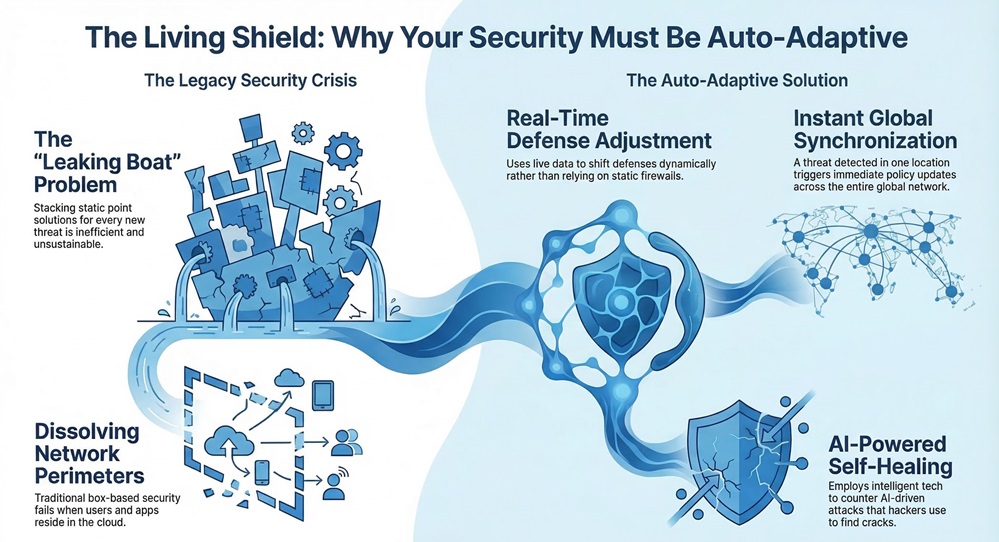
Within a SASE architecture, auto-adaptive threat prevention is not a standalone product but a converged capability embedded across every layer of the security stack. It operates at the cloud-native Single Pass Cloud Engine (SPACE), inspecting all traffic — WAN, Internet, cloud, and mobile — through a unified pipeline that applies multiple security engines simultaneously without degrading performance.
The term 'adaptive' is key. These systems don't wait for a human analyst to update a rule or deploy a new signature. Instead, AI-driven models analyze traffic telemetry, identify anomalies, correlate events across thousands of data points, and proactively adjust enforcement policies — all within milliseconds.
Auto-adaptive threat prevention within a SASE platform draws on several converged security technologies. Understanding each layer helps explain why this approach is fundamentally more effective than point solutions.
At the core of SASE security is a cloud-native Next-Generation Firewall (NGFW) delivered entirely as a service. Unlike on-premises appliances with fixed processing capacity, FWaaS scales elastically with demand and applies Layer 7 deep packet inspection to all traffic — regardless of port or protocol. Because it operates in the cloud, it inspects both northbound (Internet-bound) and east-west (WAN, datacenter-to-datacenter) traffic, closing the inspection blind spots that plague appliance-based architectures.
In an adaptive system, the NGFW continuously refines its application and protocol identification, improving detection accuracy over time. Its policies are enforced globally at the nearest Point of Presence (PoP), ensuring consistent protection regardless of where users or devices are located.
The IPS component within a SASE platform goes far beyond traditional signature matching. Modern cloud-native IPS engines use machine learning to identify attack patterns across encrypted traffic streams, detect protocol anomalies, and correlate threat indicators across the global network. Because the IPS operates within a multi-tenant cloud, it benefits from threat intelligence gathered across all connected enterprises — meaning a new attack vector detected in one customer's environment can trigger updated protections for all others within minutes.
Traditional anti-malware tools scan files against known malware signatures — a method that is inherently reactive and ineffective against novel or polymorphic malware. Next-Generation Anti-Malware (NGAM) within SASE uses AI-powered behavioral analysis and heuristic detection to identify zero-day threats and polymorphic malware in real time. Rather than waiting for a verdict from a remote sandboxing service — which can introduce latency and allow potentially malicious files through in the interim — NGAM delivers on-device or in-line verdicts within milliseconds, blocking threats before they reach the endpoint.
Auto-adaptive threat prevention extends beyond network-layer attacks. CASB capabilities provide visibility and control over SaaS application usage, identifying shadow IT, risky application behaviors, and data exfiltration attempts. DLP engines continuously scan data in motion to enforce data handling policies, preventing sensitive information from leaving the network — even when transmitted through encrypted channels.
These capabilities adapt to user behavior over time. Baseline models are established for each user and entity, and deviations — such as unusual bulk data downloads or access to sensitive resources outside normal working hours — trigger automatic risk assessments and enforcement actions.
The Secure Web Gateway provides URL filtering, content inspection, and malicious site blocking for all Internet-bound traffic. In an adaptive system, URL categorization and threat classification are continuously updated based on real-time threat intelligence feeds and behavioral signals. Sites that exhibit signs of command-and-control (C2) activity, phishing, or malware distribution are automatically blocked across the entire platform.
Extended Detection and Response (XDR) represents the orchestration layer of auto-adaptive threat prevention. XDR ingests telemetry from all security engines — firewall logs, DNS queries, IPS alerts, endpoint signals, and SaaS activity — and applies AI/ML models to detect anomalies that no single sensor could identify alone. Correlated threat stories are automatically generated, providing security analysts with actionable incident narratives rather than raw, disconnected alerts.
Also Read: Cato Device Posture Profiles and Checks: Enforcing Endpoint Compliance in Firewall Rules
The fundamental limitation of traditional security architecture is its reliance on a static perimeter and appliance-based inspection. Legacy firewalls and IPS systems are configured once and updated periodically — leaving windows of vulnerability between update cycles. More critically, they are architecturally limited to inspecting a single traffic path, creating the inspection blind spots that sophisticated attackers exploit.
| Traditional Approach | Auto-Adaptive SASE Approach |
| Static, signature-based detection | AI/ML-driven behavioral analysis with continuous learning |
| Periodic manual updates | Real-time, automated policy refinement |
| Single traffic path inspection | Full visibility across all edges: WAN, Internet, cloud, mobile |
| Appliance-bound, fixed capacity | Cloud-native elasticity, scales without hardware changes |
| Multiple disjointed consoles | Single converged management and analytics platform |
| Reactive: responds after breach | Proactive: detects and blocks before impact |
| Vendor-specific threat intelligence | Cross-customer, global threat intelligence pooling |
| High false-positive rate | Contextual, behavioral baselines reduce alert fatigue |
The convergence of networking and security within a single cloud-native platform is what makes auto-adaptive threat prevention architecturally possible. When security engines share the same traffic stream, the same context, and the same telemetry — rather than operating as isolated point solutions — the AI models have vastly more signal to work with, and the response latency drops from hours to milliseconds.
The manufacturing sector provides a compelling lens through which to understand the practical value of auto-adaptive threat prevention. Industry 4.0 has driven the integration of operational technology (OT), IoT devices, and IT systems onto shared networks — dramatically expanding the attack surface. Traditional machinery was never designed with cybersecurity in mind, leaving critical equipment exposed to vulnerabilities that actors are increasingly willing to exploit.
Manufacturing environments face a unique confluence of risks: legacy OT systems that cannot be easily patched, global multi-site operations spanning regions with varying regulatory requirements (including China), lean IT teams stretched by digital transformation initiatives, and an urgent need for real-time data that cannot tolerate inspection-induced latency.
A cloud-native SASE platform with auto-adaptive threat prevention addresses manufacturing's distributed reality by delivering consistent security from the nearest PoP to every site — whether a flagship factory in Germany, a production facility in China, or a remote warehouse in Southeast Asia. Threat prevention policies are enforced uniformly across all locations without requiring on-site security appliances to be patched, updated, or managed locally.
For example, a global glass container manufacturer deployed SASE across 70 plants in 19 countries, achieving robust, automated threat protection while simultaneously reducing communication costs by 20% — demonstrating that adaptive security and operational efficiency are not trade-offs.
In manufacturing, security cannot come at the cost of operational continuity. Auto-adaptive systems using behavioral baselining are particularly well-suited to OT environments: they learn what 'normal' looks like for each device and flag deviations without requiring pre-defined rules for every possible threat scenario. A CNC machine that suddenly starts initiating outbound connections to an unknown IP address is identified as anomalous and blocked — without any human analyst needing to write a new rule.
Also Read: Enforcing Firewall Policies with Cato SASE Device Attributes: Extending Zero-Trust to Every Device
One of the most powerful — and often underappreciated — aspects of auto-adaptive threat prevention within a cloud-native SASE platform is its ability to leverage collective threat intelligence at scale. Because the platform serves thousands of enterprises globally, every threat detected across any customer's environment enriches the intelligence available to all others.
This creates a compounding security advantage: the more traffic the system processes, the more accurate its behavioral models become. Polymorphic malware that successfully evades detection in one environment triggers an updated NGAM signature or behavioral pattern that is immediately propagated across the entire platform — turning each near-miss into a learning event that strengthens collective defenses.
Threat intelligence is also enriched by DNS telemetry, certificate transparency logs, dark web monitoring, and threat feeds from global security research teams. This multi-source intelligence is ingested into the XDR layer, where AI correlates signals that would otherwise remain invisible in isolated point-solution environments.
Auto-adaptive threat prevention is most effective when security decisions are tied to identity rather than IP addresses. In a SASE architecture, Zero Trust Network Access (ZTNA) ensures that every access request — from any user, device, or location — is continuously authenticated and authorized based on dynamic risk signals.
This means that adaptive security isn't just about detecting external threats; it's about continuously evaluating the trustworthiness of internal actors. A user whose device has been compromised, whose location has suddenly changed, or who is attempting to access resources outside their behavioral baseline will trigger automatic risk elevation — restricting access or requiring additional verification without manual intervention.
Identity-driven security also eliminates the lateral movement pathways that attackers rely on after initial compromise. By micro-segmenting the network based on identity and application context, SASE limits the blast radius of any successful breach.
A common concern with cloud-based security inspection is latency. If security inspection adds meaningful delay to application performance, users will find workarounds — defeating the purpose of the controls. Auto-adaptive threat prevention within a well-architected SASE platform is designed to deliver full security inspection without adding latency to the user experience.
This is achieved through several architectural decisions: colocation of PoPs with major Tier 4 datacenters (often providing same-datacenter latency to SaaS applications), single-pass architecture that performs decryption, inspection, and enforcement in one pipeline pass rather than sequentially, and AI-accelerated classification that delivers verdicts in milliseconds rather than seconds.
Crucially, the SLA for a true SASE platform should not carve out exceptions for security processing. The SLA covers the complete experience — networking and security — providing enterprises with the confidence that adaptive protection doesn't come at a performance cost.
The "old way" of security is a recipe for burnout. We've seen too many IT teams spend three years trying to make different vendors work together, only to have the system fail when it matters most.
At Cato Networks, we believe security should be simple, global, and smart. We're focused on helping you reclaim your time so you can focus on growing your business instead of just keeping the lights on. It’s time to choose the SASE way.
| Takeaway | Why It Matters |
| Auto-adaptive threat prevention learns continuously | Static signatures cannot defend against polymorphic or zero-day attacks; adaptive AI models improve with every data point |
| Convergence is architecturally essential | Security engines sharing the same traffic context produce far more accurate detections than isolated point solutions |
| Full traffic visibility eliminates blind spots | Inspecting only northbound traffic while east-west traffic goes unexamined is the gap attackers exploit most |
| Global threat intelligence multiplies effectiveness | Cloud-native, multi-tenant platforms pool threat signals across thousands of enterprises, benefiting all customers simultaneously |
| Identity-driven access reduces blast radius | ZTNA limits lateral movement by continuously evaluating trust — not just at login, but throughout every session |
| Performance and security are not trade-offs | Single-pass cloud architecture delivers full inspection without adding meaningful latency to user experience |
| Manufacturing and distributed enterprises benefit most | Industries with global, multi-site, OT-integrated environments gain disproportionate value from converged, adaptive security |
No. A traditional firewall is like a locked door. Auto-Adaptive Threat Prevention is like a security guard who recognizes your face but checks your ID again if you start acting strangely.
Actually, it often makes it faster. By using a single-pass architecture in the cloud, you remove the "hops" between different security appliances.
With SASE and ZTNA (Zero Trust Network Access), you can replace clunky legacy VPNs with a much more secure and seamless experience.

Surbhi Suhane is an experienced digital marketing and content specialist with deep expertise in Getting Things Done (GTD) methodology and process automation. Adept at optimizing workflows and leveraging automation tools to enhance productivity and deliver impactful results in content creation and SEO optimization.
Share it with friends!




.webp&w=3840&q=75)



share your thoughts