.webp&w=3840&q=75)
How ClickUp Enables Outcome-Based Project Management (Not Just Task Tracking)
🕓 February 15, 2026
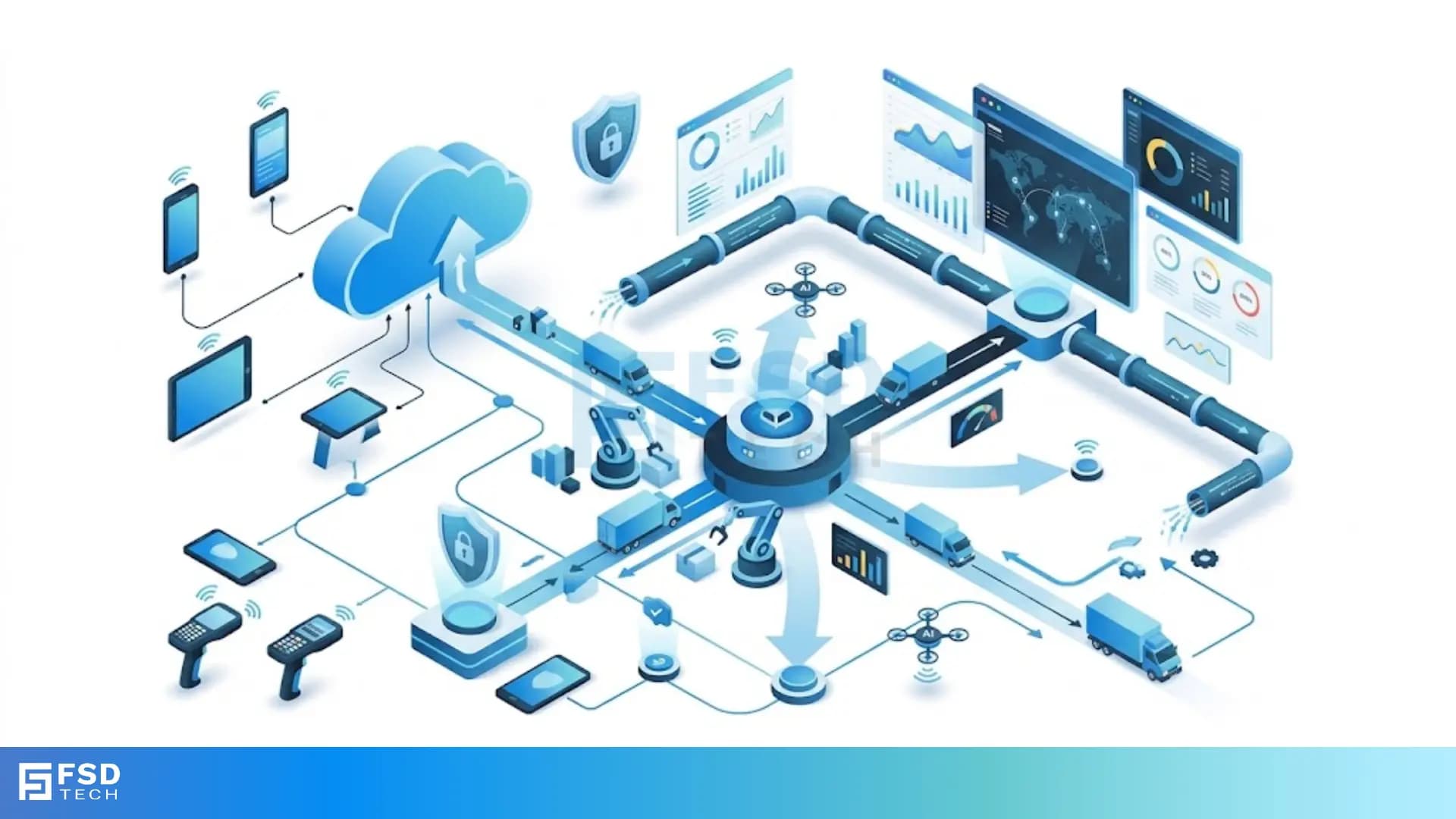
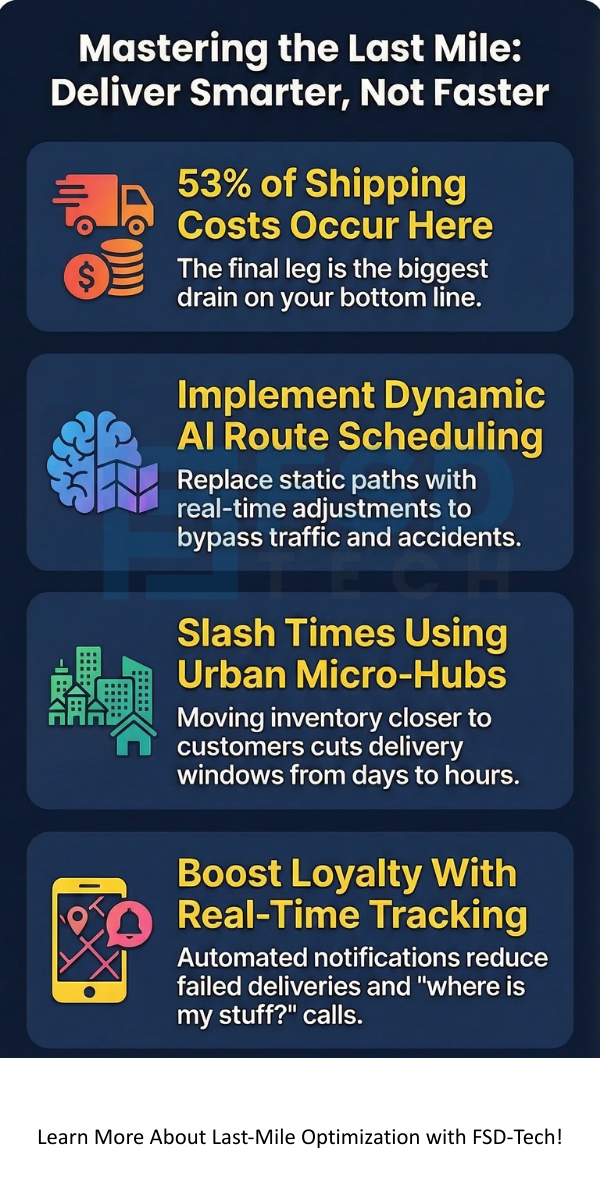
Last-mile optimization represents the most expensive and time-consuming part of the shipping process for any delivery business. If you've ever tracked a package and seen it sit at a local facility for two days, you know the frustration. For businesses, that delay isn't just a nuisance; it's a massive drain on the bottom line. Roughly 53% of total shipping costs come from this final leg. But why is it so hard to get a box from a local hub to a front door?
To be honest, the "last mile" is actually a bit of a misnomer. It might be two blocks or twenty miles. The real challenge lies in the complexity of urban traffic, hidden addresses, and the high expectations of customers who want their stuff "now." We’ve all been there—waiting for a delivery that never shows up because the driver couldn't find the entrance.
In this guide, we will explore how you can streamline your operations. We’ll look at the tech, the strategy, and the simple shifts that make a big difference. Are you ready to cut your costs and keep your customers happy?
Last-mile optimization refers to the process of making the final stage of delivery as efficient and cost-effective as possible. It involves everything from route planning to choosing the right vehicle for a specific neighborhood. Think of it as the "final sprint" in a marathon. If you stumble here, the rest of the race doesn't matter much.
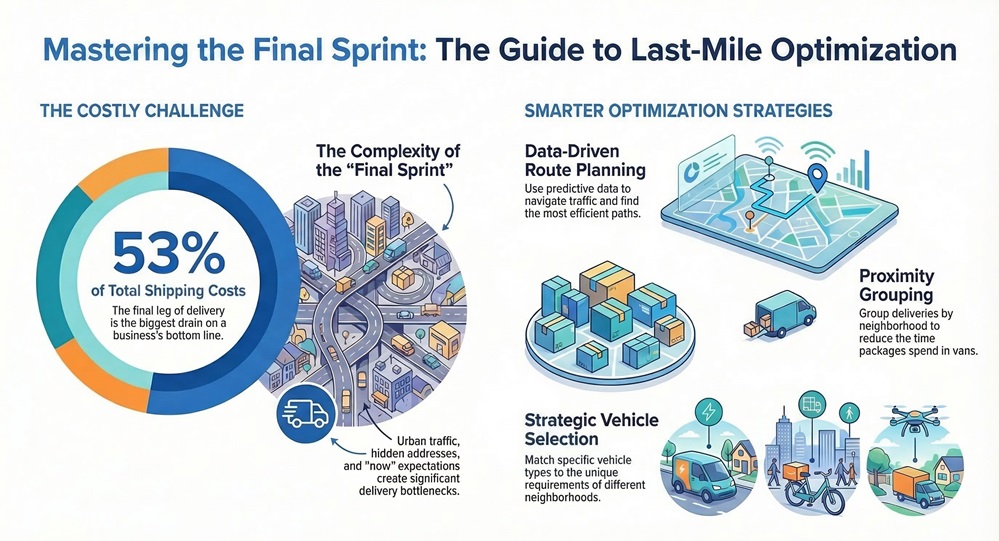
In the world of logistics, LMO (last-mile optimization) focuses on reducing the time a package spends in a delivery van. When we talk about optimizing this stage, we aren't just talking about driving faster. We're talking about driving smarter. This includes using data to predict traffic, grouping deliveries by proximity, and ensuring drivers have the right tools to finish the job on the first try.
To understand this better, let's break down what actually goes into the process:
Does your current setup handle all of these smoothly? Most companies struggle with at least one.
Last-mile optimization is no longer a luxury for giant retailers; it is a survival tactic. With the rise of e-commerce, people expect free and fast shipping. If your delivery fees are too high or your windows are too long, they will shop elsewhere. It’s that simple.
Cutting Down Ridiculous Costs
As we mentioned, the final leg is pricey. Fuel, vehicle maintenance, and driver wages add up quickly. When a driver has to backtrack because of a missed turn, you lose money. By focusing on LMO, you can significantly reduce fuel consumption and idle time.
Boosting Customer Loyalty
Picture this: A customer orders a birthday gift. Your system sends a text when the driver is ten minutes away. The gift arrives on time, and the customer is thrilled. That person is now a repeat buyer. On the flip side, a "delivery attempted" sticky note on the door is a recipe for a bad review.
Staying Competitive
Your rivals are likely already using some form of routing software. If you're still using paper maps or basic GPS, you're falling behind. Efficient delivery allows you to offer more competitive shipping rates, which is often the deciding factor for online shoppers.
Also Read: Maximum Transmission Unit: MTU Settings for Faster Networks
Now, let's discuss how you actually improve your system. It isn't just about buying a new fleet of trucks. It’s about the strategy behind the movement.
1. Dynamic Route Scheduling
Traditional static routes are dead. If a new bridge closes or a sudden storm hits, a static route becomes useless. Dynamic routing uses AI to adjust paths in real-time. This means if a driver hits a traffic jam, the system automatically redirects them to the next closest stop to save time.
2. Micro-Fulfillment Centers
Shipping from a giant warehouse three states away is slow. Many smart companies are moving inventory to "micro-hubs" inside cities. These are small storage spaces close to high-density residential areas. By starting the "last mile" closer to the destination, you cut delivery times from days to hours.
3. Proof of Delivery (POD) Tech
How many times has a customer claimed they didn't get a package? Digital POD tools—like taking a photo of the box on the porch or a digital signature—protect your business. It also gives the customer peace of mind.
4. Better Communication Loops
We've all felt the anxiety of an "out for delivery" status that lasts eight hours. Automated notifications keep the user in the loop. This reduces the "Where is my stuff?" calls to your support team, which saves you even more money.
Technology is the heartbeat of modern logistics. You can't manage a hundred deliveries a day with a spreadsheet and a prayer.
Real-Time Tracking
GPS is the baseline, but modern last-mile optimization tools go further. They track "dwell time"—how long a driver spends at a single stop. If a driver is taking 15 minutes to find an apartment in a specific complex, you can note that for future deliveries.
Data Analytics
Data tells a story. Over time, your delivery data will show patterns. Maybe Tuesdays are always slow in the downtown area. Maybe a certain driver is great at residential stops but struggles with commercial ones. Using this info helps you assign the right tasks to the right people.
Use of Acronyms in the Industry
In professional circles, you’ll hear terms like TMS (Transportation Management System) and WMS (Warehouse Management System). These systems must "talk" to each other to make the final delivery work. If the WMS doesn't tell the TMS that a package is ready, the driver waits, and the cycle of delay begins.
Also Read: SASE Point of Presence (PoP): The Heart of Cloud-Native Networking
To be honest, it isn't all smooth sailing. There are plenty of things that can go wrong, even with the best software.
Urban Congestion
Cities weren't built for thousands of delivery vans. Parking is a nightmare, and traffic is unpredictable. This is where small vehicles, like e-bikes or scooters, are starting to gain traction in LMO strategies.
The "Empty Miles" Problem
"Empty miles" happen when a van travels back to the hub with nothing inside. This is a waste of fuel and time. Optimization helps by planning "pick-ups" on the return trip, ensuring the van stays productive as long as it's on the road.
High Fail Rates
A failed delivery is the ultimate profit-killer. You've paid for the fuel and the labor, but you still have the package. Most fails happen because the customer wasn't home or the instructions were unclear. How do we fix this? Better data and better communication.
If you're feeling overwhelmed, don't worry. You don't have to change everything overnight. Here is a simple roadmap to get started.
Step 1: Audit Your Current Costs
You can't fix what you don't measure. Calculate your cost per delivery. Include fuel, labor, and the cost of failed attempts. This gives you a baseline to improve upon.
Step 2: Invest in Routing Software
Look for a tool that offers real-time updates and driver tracking. This is the single biggest "win" for last-mile optimization. Even a basic system is better than no system.
Step 3: Analyze Your Fleet
Do you have the right vehicles? Using a huge box truck for three small packages in a narrow alley is inefficient. Consider a mix of vehicle sizes to match the density of your delivery zones.
Step 4: Train Your Drivers
Your drivers are your eyes and ears. Teach them how to use the software effectively. Encourage them to report "bad addresses" or difficult delivery spots so the system can be updated.
Step 5: Gather Feedback
Ask your customers how the delivery went. Did they like the tracking? Was the driver polite? This qualitative data is just as important as the GPS coordinates.
Where are we heading? Fast-forward to five years from now, and the "last mile" might look very different.
Autonomous vehicles and drones are no longer science fiction. While we aren't quite at the point where a robot will knock on every door, we're getting close. Some companies are already testing "sidewalk robots" for short-distance deliveries.
Furthermore, the "Green Revolution" is hitting logistics hard. Electric Vehicles (EVs) are becoming the standard for urban delivery. They are quieter, cheaper to run, and better for the environment. Implementing an EV fleet is a major part of long-term last-mile optimization for many forward-thinking brands.
Last-mile optimization is the heartbeat of a successful modern business. We’ve seen how it cuts costs, keeps customers smiling, and gives you a leg up on the competition. In our view, the companies that ignore this final step are the ones that will struggle to stay relevant. It's about more than just moving boxes; it's about honoring the promise you made to your customer when they clicked "buy."
At our core, we believe in building logistics solutions that treat every package like it's the only one that matters. We're dedicated to helping you navigate these complexities with ease. Your success is our mission, and we're here to make sure your last mile is your best mile.
Ready to transform your delivery operations? Contact our team today for a custom audit of your logistics chain!
Traffic and urban density are usually the biggest hurdles. Finding parking in a busy city can add minutes to every single stop, which destroys a delivery schedule.
By creating shorter, more efficient routes, vehicles spend less time on the road. This directly leads to lower fuel consumption and fewer emissions.
Not at all. Small businesses can use affordable SaaS (Software as a Service) tools to plan better routes and communicate with customers, often seeing a return on investment within months.
Yes. AI can process millions of data points—like historical traffic patterns and weather—to suggest the best possible route in seconds, something a human simply can't do.

Surbhi Suhane is an experienced digital marketing and content specialist with deep expertise in Getting Things Done (GTD) methodology and process automation. Adept at optimizing workflows and leveraging automation tools to enhance productivity and deliver impactful results in content creation and SEO optimization.
Share it with friends!




.webp&w=3840&q=75)

share your thoughts